


One of the more interesting things I encountered when first starting out with landscape photography, back in the days of film, was staunch resistance by many photographers to take double exposure photographs. These photographers felt that a photograph should represent the scene as the eye saw it with no manipulation. This type of attitude instantly put photographers in one of two camps, pro-double exposure or anti-double exposure. The times have changed, but the philosophical debate on double exposures has yet to subside. Some might say the debate on double exposures has intensified with the advent of digital photography and the ease of editing images in Photoshop.
Mastering the art of film double exposures was and is quite a challenge. To get a double exposure to work and look proper it required a good amount of vision, memory and technical skill. First you’d compose your image leaving room for the subject of your next exposure, evaluate exposure, set your exposure, take the picture, recompose to your next subject, adjust your exposure and take the picture. For additional exposures you’d repeat this cycle. Some cameras would enable photographers to take very elaborate multiple-exposure shots making the process that much more complex. None-the-less in the eyes of purists double exposure photos were just plain blasphemy.
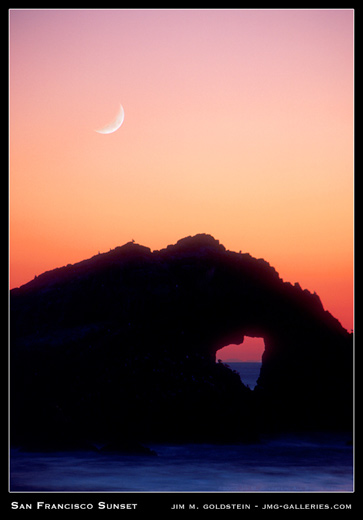
A good old fashioned film double exposure
Enter digital photography and digital editing…
As digital has become more mainstream, more and more scrutiny is given to photographs. Photography viewers are a little wiser to the ways of the world and often don’t take what they’re viewing at face value. Much of this viewer skepticism can be attributed to the expanded use of photo editing applications such as Photoshop. Given that the viewing audience is more skeptical the art of double exposures, although technically easier to accomplish digitally, is far more difficult to get past viewers.
Digital double exposures are quite straight forward. You take two separate photos, extract one element from one photo and add it to another. The challenge comes in scaling and blending the added element. Now that this process is so much easier those employing it face additional scrutiny from purists, moderates, even old school film users and as mentioned photo viewers.
Having started off as a photographic purist I’ve since developed into a pragmatist. Why? As a photographer I’ve come to learn that you should never let yourself become preoccupied or handcuffed by such philosophical debates. Photography is not a clinical occupation, it is an art form. As such knowing when, not just how, to bring more to an image is what will always set apart average photographers from great photographers.
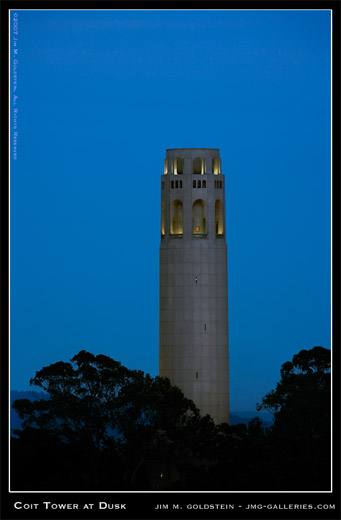
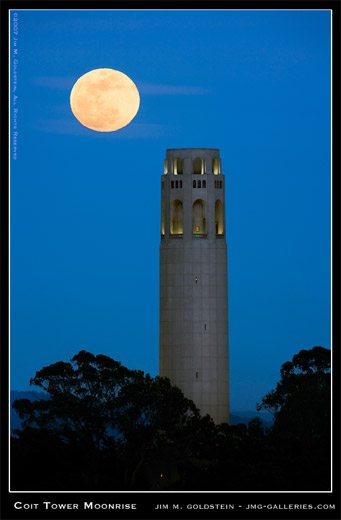
That being said I first strive to capture a scene with out any manipulation and for the most part 98+% of my photos are straight shots. The remaining photos sometimes benefit from a little artistic license such as “Coit Tower at Dusk” being digitally transformed into “Coit Tower Moonrise”. (Note that all elements of this shot were taken with in the span of a few minutes.) As with most things in the world of art how often and to what degree you apply particular techniques is subjective. Each photographer has their own philosophical outlook and comfort zone. For myself a realistic double exposure, digital or film, is as attractive as a straight shot.
[tags]digital, double exposure, photo, photography[/tags]
(non-journalist) photography is an art, and all art is subjective.
You may have just inspired me to try this out — never thought to do this with my own work. I think it’s great, and I applaud those who do it well. As long as it doesn’t hurt anybody, it’s OK by me. I don’t see anything wrong with doing this to photos of an artistic nature — but as Steven said, photojournalism is a different story.
Personally I don’t care for it because it makes people question the validity of anything spectacular in nature. Particularly amongst those who haven’t spent as much time observing the natural world.
From an art point of view, while they look cool, such as some of David Muench’s book covers, I just don’t find myself as impressed emotionally with knowing it is a double exposure as opposed to knowing it was a found image.
Great point Steven. Clearly double exposures or digital manipulation of any kind would not be appropriate for photojournalism. As for other genres, some have a hard and fast interpretation that photography’s main purpose is documentary versus reflective/interpretive. That is where this debate usually falls.
Brian I’m curious to see what you come up with as you try this.
Richard I agree with you in one regard and differ in another. When it comes to recording the natural world as a photographer there is a let down in some instances when I find out that a double exposure was used. As a photographer though I also now know when an image is a double exposure and when a photograph surpasses normal dynamic range. If for example a moon is added and its representation is natural looking then I have no problem with it. On the other hand if the moon is gigantic and out of proportion then the technique comes across very cheesy. The natural use of a double exposure is not necessarily a bad thing. Just because my camera can’t capture what I see in one shot it doesn’t mean that what I portray with a double exposure is not what nature revealed to me.
To me it falls in the same category as whether you photographed a captive animal instead of a wild animal. As long as you disclose, I don’t see any problem.
By the way, is *this* photo real or is it memorex?
http://tinyurl.com/2bnv3o
Richard’s remark reminded me of this photo, which I just recently came across. I figured it was just a good shot with an amazing lens (could it be wide angle with that straight tree in the bg?), but someone else believes it is a Photoshop creation.
The visual world isn’t made of photographs. It’s much more complex than than. The process of taking all of the visual information out there and creating a 2-dimensional image with a camera and a computer is not so simple as it might seem. As one photographer friend put it, “Of course pictures lie. All pictures lie. That’s what they do.”
If your goal as a photographer is purely artistic (ie not documentary), then it can be fun and interesting to play with the boundaries of what can and “should” be done to create an image.
Pingback: Digital Double Exposures: Blasphemy or No Big Deal? at Imaging Insider
John W. another interesting perspective. I never thought to tell people explicitly, but I’m the sort that aims for the double exposures to look as natural as possible. I’m not sure most people care other than photographers. Somehow photographers feel duped or fooled with double exposures and I never understood that.
BTW I think that mushroom picture is real based on the other photos he has on the site. It looks like the combination of angle, depth of field, crispness of the digital image and reflected light on the underside of the mushrooms give it an unreal look. One could say a perfect storm of conditions that make it look fake.
Eliya… great comment. I like your friends quote quite a bit.
coming from the design/art side first and delving into photography later gives me a perspective that many photographers don’t have. as part of my work, i would take existing photography and merge in other elements of photography and text and illustration to make a unique piece. so if someone asked, “do you consider that photography?” i’d have to say, “no, i didn’t even necessarily take any of the photos involved! it’s compositing.”
for me photography is:
if it was there and i captured it at that moment in time, it is accurate and photographic. correcting for levels, color balance, dust and sharpness is acceptable. but adding or subtracting elements takes it out of the realm of photography and into the realm of art or composition. this evokes the compositing style of dave mckean and the like.
at that point, you are using photography to “support” creation of art or design. but it is no longer just photography.
that said, there is nothing wrong with it, as long as it is disclosed as artistic license, and not sold as an actual event.
Pingback: G Dan Mitchell | Photography » A Note About Today’s Photo
I emailed Jim last night and he suggested posting again here:
I think disclosure has more to do with being viable for use in the scientific and education fields as well in addition to editorial rather than photographers opinion.
Galen Rowell also once cited an example of where his best-selling “Rainbow over Potala Palace” image totally bombed commercially as a poster print many years ago because the general public thought it was a double exposure image. I was told that he earned well over a million dollars from licensing and selling prints of that image through the years, so the poster example does show that seeds of doubt does have an effect on photography no matter who the name of the photographer is. And Galen was a guy who didn’t even want to fix a hole in one of his best slides!
Personally I don’t really care what others do, but it does drive me nuts when someone asks me “Is that real?” And I don’t even add objects or composited skies to my images. The only response I can come up with is, “Spend more time observing nature and you’ll see much more amazing stuff that anything in my photos.”
Ron wrote:
“… adding or subtracting elements takes it out of the realm of photography and into the realm of art…”
Not quite sure how to respond to that – except to say that my goal is to create photographs that are art.
Dan
Personally, I don’t really care how the final image was produced, single exposure or multiple exposures, as long as it’s “authentic”. By that I mean if the final photograph was a composite of multiple shots from the same location within seconds or minutes apart.
Now, if cameras/film had the same dynamic range as human eyes, there would be no need to blend multiple exposures. We can just go out and shoot instead of having this discussion 🙂
Pingback: World Design O! » Digital Double Exposures: Blasphemy or No Big Deal?
Pingback: PhotoNetCast #7 - Editing and Processing in Photography | PhotoNetCast