


| After reading this article I highly recommend reading: Facebook’s Terms of Use: From Bad to Beyond Worse Published February 17, 2008 |
Last week in my post “How The Rights To Your Photo Are Being Hijacked Through Photo Contests & Social Media” I mentioned that social media sites like Facebook were grabbing the rights of submitted photos as many photo contests are now doing. Clearly this trend to grab the rights of submitted photography by any organization is alarming.
After my initial post I decided to take a closer look at how Facebook references images as I used the site through out the week. As I accessed friends profile pages I’d check to see how images were being referenced in their personal photos section and/or through Facebook applications. What I found really alarmed me.
As noted in my original post I found it unseemly if not unethical that any organization would conceal a rights grab of user-generated content (photography, music, lyrics, writing, etc.) by burying it in pages of legalese. If the terms in the Terms of Use weren’t confusing enough for the average person (see below) it gets even more confusing. Facebook is unique among social media sites in that they support an application platform. Independently created Facebook applications enable members to take quizzes, aggregate content from blogs and other social media sites, give gifts, post photos in picture frames, etc.
What I found is that unknowingly people using applications that reference photos are in fact indirectly posting photos to Facebook subjecting them to the excessively far-reaching terms specified in their Terms of Use. It’s not very obvious but many applications that you’d think would reference images from their source location (say a blog for example via Flog Blog) are in fact duplicating images and hosting them on Facebook. The net result being images hosted on Facebook as though you had manually uploaded them. The distinction legally is identical, but is far from obvious for the end user.
Want to know if the photo you’re seeing on Facebook is hosted in Facebook? Right click on the image and view properties. What you’ll find is that ALL copies of your images are hosted on a Facebook server (example domains: “photos-d.ak.facebook.com”, “photos-921.ll.facebook.com”, etc.)
When you post User Content to the Site, you authorize and direct us to make such copies thereof as we deem necessary in order to facilitate the posting and storage of the User Content on the Site. By posting User Content to any part of the Site, you automatically grant, and you represent and warrant that you have the right to grant, to the Company an irrevocable, perpetual, non-exclusive, transferable, fully paid, worldwide license (with the right to sublicense) to use, copy, publicly perform, publicly display, reformat, translate, excerpt (in whole or in part) and distribute such User Content for any purpose, commercial, advertising, or otherwise, on or in connection with the Site or the promotion thereof, to prepare derivative works of, or incorporate into other works, such User Content, and to grant and authorize sublicenses of the foregoing. You may remove your User Content from the Site at any time. If you choose to remove your User Content, the license granted above will automatically expire, however you acknowledge that the Company may retain archived copies of your User Content. Facebook does not assert any ownership over your User Content; rather, as between us and you, subject to the rights granted to us in these Terms, you retain full ownership of all of your User Content and any intellectual property rights or other proprietary rights associated with your User Content.
– Facebook Terms of Use as of today 2/26/08
How does Facebook’s approach differ and why does it matter?
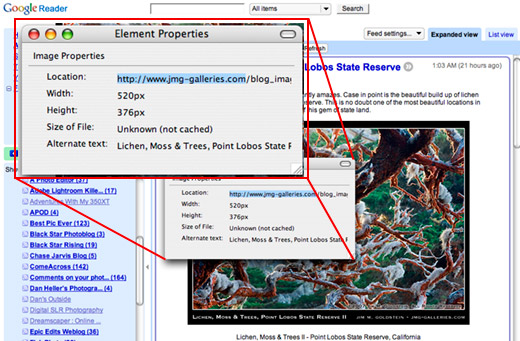
Some of the more common Facebook applications reference and pull content via an RSS feed. RSS feeds as they behave in most other applications such as RSS Readers reference content from their source location. For example I host my images on my web server and reference/link to them in my blog entries. RSS Readers then display my blog entry and image in a web browser. The image in my blog post is then displayed and served from my server. Facebook on the other hand reads the RSS feed and then duplicates the image from the source server and then serves up the image from a Facebook server.
Image Location on Facebook
Note: Although this exemplifies a Flickr RSS feed the same is true of my blog RSS feed via the “Flog Blog” application.
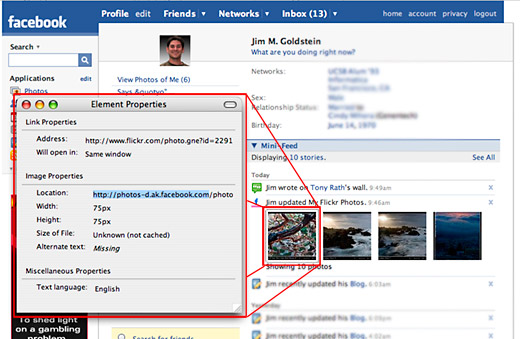
Image Location on Google Reader
The combination of this content duplication and the far-reaching terms of their Terms of Use should alarm every Facebook user not just photographers. I am certain that components of the quoted Terms of Use regarding user-generated content are necessary. Displaying content online is a worldwide affair and not every image is formatted to fit Facebook’s layout. Facebook chooses to go farther than is necessary. In all my time posting photos online I have never seen a site claim the right to “sublicense” submitted work. Much of the terms “irrevocable”, “perpetual”, “fully paid”, etc. are excessively one sided particularly in combination with their follow-up term of grabbing the right to “distribute such User Content for any purpose, commercial, advertising, or otherwise“.
Let it be known no web site is free. It may seem like you’re getting to use a free web site, but companies like Facebook, Google, etc. are providing online services in exchange for your personal data that is used to serve advertising; advertising that they charge a pretty penny to display. Whether you realize it or not you are bartering your personal information for their online services. Facebook is taking it one step further by grabbing the rights to user-generated content namely your photography.
For many giving up privacy by serving up your personal information to such companies is an acceptable sacrifice. That acceptable sacrifice has its limits as Facebook found out with their Beacon online ad system in late 2007. I would argue that Facebook to date has dodged a bullet in that most people are unaware of the broad terms that amount to a rights grab of user generated content on their site. Facebook should be pressured to revise their Terms of Use as they were pressured to modify Beacon. Until that time I will no longer have my photography displayed in any form on Facebook.
[tags]Facebook, rights, copyright, photo, photography, ToU, Terms of Use, Google, advertising, Beacon, UGC, user generated content[/tags]
“…and you represent and warrant that you have the right to grant…” – I wonder if this places the burden of model release on the photographer too? If Facebook took one of your photos and published it, in advertising for example, and people in the photo sued Facebook for use without model release, could Facebook in turn sue you?
Thanks Jim for taking the time to conduct this research and also inform the broader photo community about these issues.
I have always taken the time to read terms of use before I join and social media of web entity. I have been fortunate that I have many years of experience with contact law and therefore I am lucky to be actually able read the terms, but still at times because it is legalise I have to work hard to string the conditions together to form the condition of term.
After many views and ideas of the theft of copyright I am starting to settle into a position that seems at least comfortable now.
For me the final product of my photography effort is still the print. Not a 4×6 but a larger and well made print that has all the subtle tones and hues you would expect form a well made fine-art print.
The images I post on the web are never larger that 800 pxs on one side and therefore would only make a 4 in print and even then since I use about 70% for image compression not a great 4×6 could be made.
These are to me only post cards or facsimiles of the real image I can make and are more like tourist snapshot of a great painting, not that my images are great yet.
So for the most part I don’t really worry about people stealing my images as they will never ever be able or even be close to producing the large fine prints I am able to.
I do copyright all my work and specify this on my sites and if I see one of my images being used for commercial purposes then I will pursue vigorously.
In the photo attorney
Report: Copyright Victory by Stock Photographer
http://www.photoattorney.com/2008/02/report-copyright-victory-by-stock.html
There is a good article with legal transcripts where a photographer sued for copyright theft and also was able to recover damages.
Niels Henriksen
@Niels thanks for the reply. Although your concern about unauthorized prints is a valid one the ever increasing use of imagery online by companies of all types makes low resolution imagery (even at 800px) highly susceptible to infringement. Low resolution images are used often in marketing banners, web page content, and videos. Web marketing is a booming field and there is a large demand for images. Not all people running web marketing campaigns are aware of the rules around image use as we see quite often with various stories surrounding Flickr.
I too post my images at a size no greater than 800px and I am now considering posting images of an even smaller size. Multiple factors are being considered in this evaluation. 800px still provides a mechanism for people create small prints even if not high resolution that can be incorporated into printed marketing collateral and as I mentioned can be easily placed in online content as well.
I personally would find it a shame to post anything less than 800px wide or high. The alternative I’m considering is expanding how I watermark my images.
This concern is just the latest development of how I navigate the demand for images online, but the core issue is the concerted effort that media companies are taking to grab rights to imagery and other user generated content. I think there is a misconception that just because you upload a small file size or put a watermark that you’re protected. The reality is you’re not. I still would like to give people the benefit of the doubt that they’re not out to steal work. Even assuming the best of an organization like Facebook their terms give them broader license to do what they want with submitted content. If there is no intent to go above and beyond resizing an image to make it fit in their site page layout then they need to scale back the overreaching terms they outline in their Terms of Use. Joining a social media web site shouldn’t amount to checking all your usage rights at the door for the content you provide that in essence ads value to their community.
Thanks for writing about this.
I checked my Facebook Flickr app, Flickr Photosets, to see how they were storing images and it was split. The thumbnails that appeared in my profile and news feed were hosted on a subdomain of Facebook, whereas the full image was loaded from its location on Flickr.
Under those circumstances I wonder how the terms would apply. If I have, unwittingly, uploaded only thumbnails of the image to Facebook surely that assumed license would not apply to the larger image. Although I suppose I have no idea if the full size images have been copied to Facebook or not.
I assume the thumbnails are copied to Facebook to make loading of those pages smoother, saving them from having to look to another domain for content.
@Miles the Flickr thumbnails are less of an issue. It is when a larger image, say from a blog post, is copied and resized to fit the Facebook layout or larger images are placed inside the Big Photo application or an equivalent that things become worrisome. I should have noted that if a thumbnail or a small version of a photo on Facebook links to a non-facebook site, content on the non-Facebook site will fall outside of the Facebook ToU. The concern only falls with content (images, videos, music, etc.) that are copied and/or hosted on Facebook servers.
Niels – I post images no bigger than 700px on a side, but a few months ago I discovered a local camera shop was using my images of the local area on their digital photo frames to show off to customers. Obviously without my permission. Since then I’ve taken to adding a byline at the end of each image, just so the thieves have to go through one more step to misuse my photos.
Even if you’re not a member of Facebook, what if someone adds your Flickr feed to their Facebook account. Doesn’t Facebook get to use those images too?
Pingback: I Quit Facebook » Blog Archive » Facebook stealing your photo rights?
Lots of good comments here and further info that helps to shape our views.
My expertise is Risk Management and I take a similar approach to my photography. I try and evaluate the risk and benefits for posting on-line to any potential loss to;
Most of my income does not come from photography but it is the one thing that keeps the lights really shinning brightly inside me.
If every person took one of my images and hung it on a wall or screensaver I would not be troubled by that. It would be nice if I could get some recognition, but life sure isn’t perfect.
I sell large prints and these cannot be duplicated.
As I mentioned if by chance I did see one of my image in a commercial venue I would try and collect appropriate fees, but I do not worry to much about that because most likely since they stole it, they would have found another way to a similar image free and would not have paid me first. There might be the old image that was so unique that it could not be duplicated, but very rare.
No real loss of income, only potential to reap after the fact.
I have tried watermarking the image but the outcome made me not really happy.
Hard to get the right outcome without destroying the image too much.
There are some risks but for my photography business model I will not loose too much by the odd theft as I don’t pursue that venue anyway.
Niels Henriksen
OMG…That’s how ‘Those Photos’ got online! lol…oh, well. I will be more careful in future. Thanks.
480 x 320 & 250 x 167… 🙂
Pingback: FocalPower…the blog » Blog Archive » Another Angle of Facebook’s Rights Grab
Thanks for the write-up. A friend of mine just informed me of a story about someones photo being swiped by Facebook, sold to an advertising company in Europe, who then posted this persons picture on a side of bus. Yes, probably a bit of exaggeration but it got me thinking how easy it is for anyone online to ‘borrow’ images, especially sites like Facebook who have access to millions of photos and very few users (including myself) who read thru the fine print.
@Mackie Images have a link or story to back up the swiped image claim? I’d be interested to see more details on this. Thanks for the comment.
Thank you for pointing this out. Sincerely appreciated-
With Light,
Christen
Pingback: Why I do not post my work on Facebook, Myspace, and other online social websites - and why you shouldn’t either « Katy Osterwald
[…] A recent post by Jim Goldstein about Facebook’s rights grab raises some timely issues for photographers regarding protecting their rights. I wanted to share an alternative view of this situation along with some things that FocalPower is working on that helps to address this recurring problem. […]
Thanks for the write-up. A friend of mine just informed me of a story about someones photo being swiped by Facebook, sold to an advertising company in Europe, who then posted this persons picture on a side of bus. Yes, probably a bit of exaggeration but it got me thinking how easy it is for anyone online to ‘borrow’ images, especially sites like Facebook who have access to millions of photos and very few users (including myself) who read thru the fine print.
Pingback: FACEBOOK COPYRIGHT AND USER (DIS)CONTENT. KNOW YOUR RISKS. « SHIMWORLD
I was convinced to start a FaceBook account by friends. They kept urging me to put photos up as it would drive traffic to my photography sales on my website. I resisted. Tonight, I decided to upload just a few. Just for kicks, I opened one as large as it would go and used the Vista Snipping Tool to draw out the image and save to my desktop. I was able to open it in the Windows Photo Gallery and print a very nice 8×10 picture. I was horified that it was THAT easy to copy and print my image. I immediately deleted the entire album and started researching what rights I was giving away, too. Finally, found the part in the TOS that is reference here. My question was what exactly could they do with my images? I realize they can use them in advertising, etc., but can they sell prints of them like I do on my photo site? How far does it go?
Pingback: Facebook’s Terms of Use: From Bad to Beyond Worse | JMG-Galleries - Jim M. Goldstein Photography: travel, landscape, and nature pictures - stock photos and fine art prints
Pingback: Shutter Photo » Facebook’s Terms of Use
all i want to know is how do i prevent face book from owning my photos…. in lay mans terms..i love sharing photos with friends.. and love my own photos..is there a way to prevent fb from owning them?
If I post a link on Facebook to a photo on my website and my webasite has RSS feed, then is facebook archiving a copy of the image and grabbibng these rights?
Daynamyte, I’d confirm it with a copyright lawyer, but how I read the TOS is as follows:
I would be very hesitant of even putting up links on Facebook even with them going back to the old TOS.
“For content that is covered by intellectual property rights, like photos and videos (IP content), you specifically give us the following permission, subject to your privacy and application settings: you grant us a non-exclusive, transferable, sub-licensable, royalty-free, worldwide license to use any IP content that you post on or in connection with Facebook (IP License). This IP License ends when you delete your IP content or your account unless your content has been shared with others, and they have not deleted it.”
You see the underline “in connection with”. That gives them a rights grab on anything you post on Facebook up to and including blog-links. When you post a link on Facebook, you have “posted on” and the link content is published “in connection with” Facebook’s internet protocol thereby allowing them to sneak in and grab any content on the posted link. Confirm it with a lawyer, but that means I’m out as far as posting any content or links. I will not be putting any of my stock photography on Facebook. If they want to see them, they can go to my blog.