


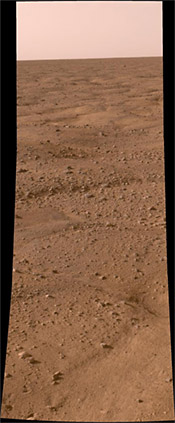
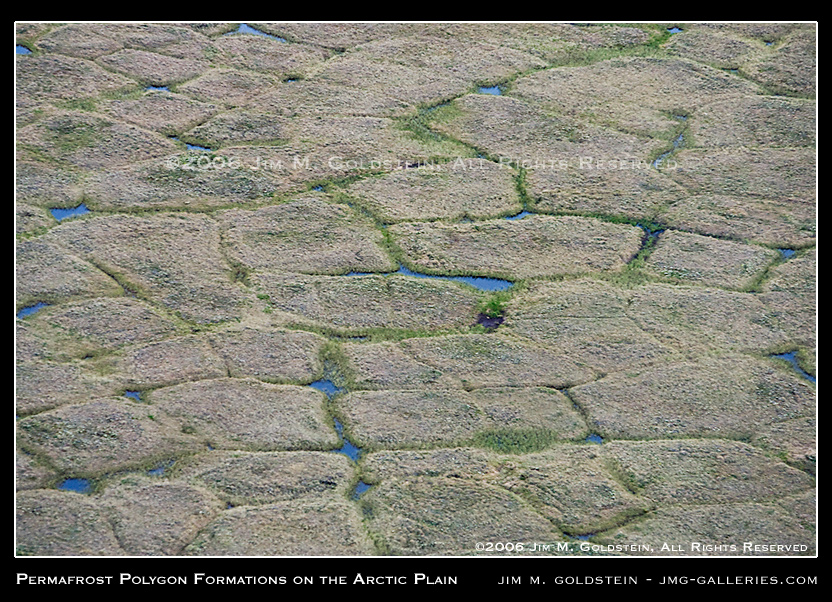
One of the most exciting developments to occur this weekend was the landing of the Phoenix Mars Lander. Landing on the northern pole region of Mars, amazing photos were sent back detailing unusual, yet familiar looking polygonal shapes in the polar landscape. Upon seeing these photos I didn’t need to read a word on the NASA Phoenix Lander web site about what I was seeing. From my trip to the Arctic National Wildlife Refuge I knew exactly what these polygonal formations represented… permafrost or permafrost like conditions.
Below on the left is one of the first photos transmitted from the Phoenix Mars Lander and on the right is an aerial view of the Arctic Coastal Plain. The lifeless/waterless surface of the Mars polar region looks very similar in form to our very own northern polar region. This discovery once again showing another facet of how the mathematical and physical laws of nature repeat from micro to macro and from planet to planet.
 |
 |
| Click to Enlarge | Click to Enlarge |
The presence of permafrost formations on Mars and Earth is but one of many fascinating instances of forms repeating throughout nature from the microscopic to the interstellar. A commonly repeated forms observed is the logarithmic spiral as seen below in Hurricane Isabel and M51 (photo by Brian Lula). This particular form is far more common than the polygonal permafrost formations, but all part of the mathematical uniformity stemming from the molecular structure of all things that compose matter in our universe.
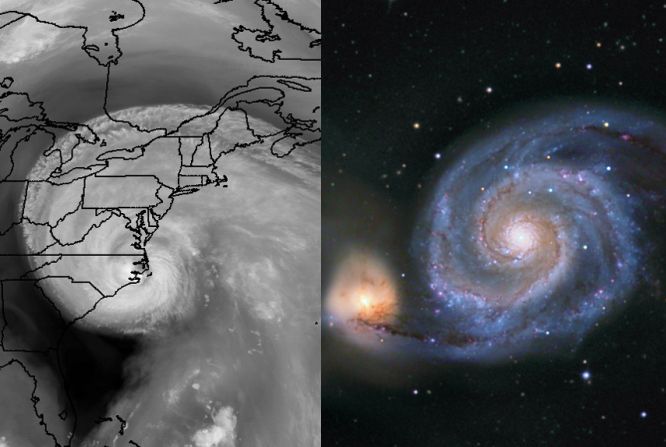
Logarithmic Spirals Isabel and M51 – APOD
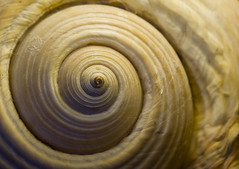
Spiral by minipixel
The recent photos from Mars are not only a distant view to another planet, but a view to the common inner working of how our Universe is built. Nature truly is an amazing thing to study as well as take in visually.
[tags]Mars, NASA, Phoenix Mars Lander, permafrost, polygon, formation, landscape, photography, nature, shape[/tags]
I know exactly what you mean Jim. I love looking out for symmetry in various scales and location, and I find them in the least expected places:
Dye in milk: http://neil.creek.name/blog/2008/05/02/dyed-in-the-milk-print-available/
Clouds of Jupiter: http://science.nationalgeographic.com/science/enlarge/jupiter-clouds.html
I’m very excited about the Phoenix mission, and watched the landing live on NASA TV. We live in such inspirational times, and being able to be connected via our photography with nature is one of the rewards of our pastime.
Thanks for this inspirational post!
Great post Jim. The symbiotic repetition of shapes and geometry within nature are truly incredible – and as your post points out, it isn’t simply earthly nature, but universal. You provided some great examples here. I am also looking forward to the new discoveries from the lander. I only hope that within my lifetime, life is actually discovered.
@Neil very cool similarity between your dye/milk photos and Jupiter’s gas clouds. The developments from this NASA mission should be great to take in as they unfold.
@Mark A discovery of life would be the discovery of the millenium. As always it’ll be fun to see what is learned from this mission as with others past.