
Photos that Speak to an Audience
One thing I really enjoy about sharing my photography is that every so often a photo finds its perfect audience who can fully appreciate a core thought that inspired its creation. Case in point is my Light Lasso photo from Death Valley National Park that was recently published in the quarterly edition of the DarkSky.org quarterly publication Nightscape with a feature on “Seeing Blue, Blue Rich White Light”.
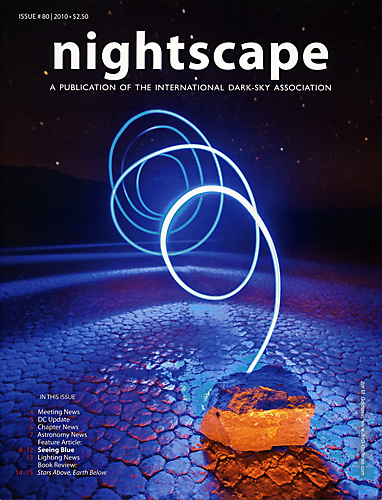
It is increasingly hard to find night skies that are not polluted by artificial light from our roadways, homes, towns and cities. The Sierra Nevada mountains, parts of the Owens Valley, Death Valley and portions of southern Utah are but a few places I gravitate toward to enjoy the stars. You’d be surprised even on a moonless night how bright the stars in night sky can be. To be able to see the arm of the Milky Way stretch from one horizon to another is breathtaking. Unfortunately such sights are increasingly rare. It’s great to see that organizations like DarkSky.org exist and in case you’re curious they do operate based on contributions/donations. I just made mine and hope you do to lend them a hand.
Technorati Tags: Death Valley National Park, Stock Photo, Stock Photography, Fine Art, Night, Racetrack, Darksky.org
| Stay Connected with Jim | |||
| Join Me On Twitter | Become a Fan on Facebook | ||
| Listen to EXIF & Beyond | My Latest on YouTube | ||


Have you ever visited Great Basin National Park? I was there a couple of summers ago and was astounded by the night sky in there. There is nothing for miles and miles around and the sky at night was breathtaking.
Plus, they have bristlecone pine trees, which makes for a fabulous nighttime photography subject.
[Reply]
Great Basin National Park would be a great spot Kiffanie. I'm eager to visit there primarily for the Bristlecone Pines. I've see the Bristlecones in the White Mountains and in Utah… 2 of the 3 locations they're found. It's a shame that one has to travel so far to find dark skies. Thanks for the comment and reminder to visit this area!
[Reply]
This is a perfect example of where my two lives meet. As you know, I'm a photographer. But you may not know that I am also a Landscape Architect and Lighting Designer. I have long promoted the philosophies of the International Dark-Sky Alliance. But I do have some criticism about IDA's approach. It's not that their basis is incorrect, but they're trying to strike up regulations that restrict business owners and land developers. Unfortunately, it all comes down to ROI, and those guys aren't willing to listen until you put it in their perspective.
Fortunately, the IESNA (Illuminating Engineers Society of North America) has weighed in on the issue, adopted most of IDA's ideals and updated their own regulations (IESNA writes the ANSI/ASHTOO energy/safety codes). They've added two important twists though that appeal more to an ROI perspective. First – Light directed skyward is a waste of energy and money. This alone hits a nerve…a landowner/developer immediately realizes that they are wasting energy that could otherwise be directed at the ground. Whats more, with dark sky compliant lighting, they can reduce the overall wattage (long term financial gain). Second – Safety. Yes, safety. The thing is that IDA's regulations speak only to light pollution and nothing else. Again, noble cause…but it falls short of a real issue, which is personal safety. The human eye (as we all know as photographers) is just not capable of adjusting to light that quickly. Cameras are even worse. So when we're dealing with light that is reaching your eye directly, this is called glare…and it prevents you from seeing clearly any object or person that falls between your eye and the light source. This is a safety concern both to drivers and to pedestrians. IESNA's definition of Glare is more restrictive than IDA's definition. IDA restricts light above 90 degrees (horizontal). IESNA restricts it above 70 degrees – which is about the angle between your eye and your brow bone.
So yes, I support IDA. But I agree with IESNA's approach more. Not only because it's approaching it from more than a pollution issue or because it's more restrictive…but because it appeals to a larger audience. As soon as you start talking possible lawsuits or ways to save operational costs…that's when you'll get the fence-sitters or even the naysayers to do things. I don't care if they're not doing it for the right reasons (environment) – so long as they're doing it.
Anyhow…congrats on getting published in this great resource, Jim. You deserve it.
[Reply]
Great info Travis! Great to support the cause to reduce light pollution by any means in my book. I do agree ROI speaks to business and government the most. Hopefull IESNA's approach helps yield some changes along with the IDA's efforts. Hopefully in tandem their efforts will net a larger improvement.
Thanks for the great comment!
[Reply]