Landscape, Nature And Travel Photography

Photography By Jim M. Goldstein

How Every Flickr Photo Ended Up on Sale This Weekend

There have been many stories over the past few years about copyright infringement on Flickr. To date most have been about individuals maliciously downloading the work of others to resell it as their own or companies using photographs commercially violating either the licensing restrictions of the photo or ignoring the need for a model release. What most remain unaware of is that Flickr fosters copyright infringement through their API. The most egregious part of this is that Flickr knows it. Even if done with out malice you can expect them to spin it that they do not foster copyright infringement through their API or, as you’ll later see, that they’re immune from being liable for improper use of their API because of their API terms of use.

6 months ago I realized that two applications leveraging Flickr’s API were ignoring photo licensing settings that every user configures in the “Privacy & Permissions” section of their “Your Account” page.  Even now regardless of a photos designated licensing setting, whether Creative Commons or All Rights Reserved, these and other applications are publishing Flickr photos to 3rd party web sites and image files, high resolution if available, are being downloaded for reuse on personal computers. Worse still is that as recently as this weekend MyxerTones employed Flickr’s API inappropriately in effect making every Flickr photo available for sale as cell phone wallpaper for 2 days.

My first realization that there was a problem with how Flickr’s API was being managed was when I found a medium size version of my photo “Penny Harvest Rockefeller Center, New York” displayed on CoinNews.net in late December 2007 just after Christmas. I wrote the administrator of CoinNews.net immediately and found out that they were unaware of the copyright infringement. It was explained to me that they were just using a freely available plugin that enabled them to publish the photographic work of others from Flickr via specified tags. The blog plugin they were using, “FlickrRSS“, was pulling the most recent photos tagged with “penny harvest” whether designated as “All Rights Reserved” or not.
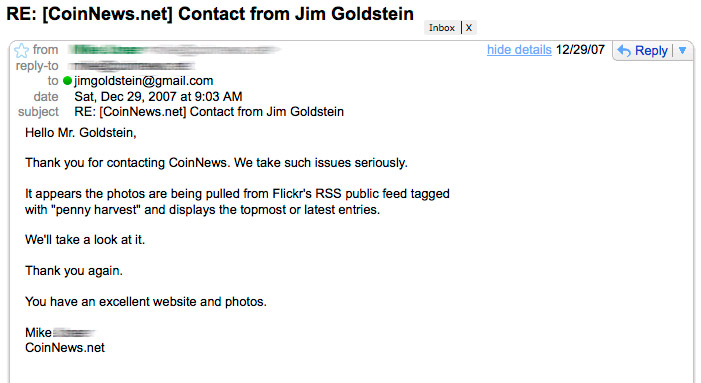
CoinNews.net's Explanation
Click to Enlarge

With in days of this discovery Dave Winer announced FlickrFan. FlickrFan creates a high resolution photo screensaver based on a user or a tag based Flickr RSS feed. Photos from the specified user(s) or tag(s) are downloaded from Flickr to a local computer without sensitivity to the copyright license chosen by the photographer. (See FlickrFan: A Heads-Up For License Conscious Flickr Photographers). I contacted Dave about this, but strangely he would only carry on a conversation through blog comments. He in essence refused my invitation to talk about how his application worked over the phone or via email. His comments created more questions than they answered. In the end it left me scratching my head as to who the responsible party is in such application development. Is Dave immune because he’s leveraging RSS feeds that pulls content in a set format determined by Flickr or is Dave responsible for constructing an application that properly factors in photo licensing information contained with in Flickr’s feeds and/or API?

To pursue the matter further I contacted Flickr in December via an email to their support team. My email went unanswered.
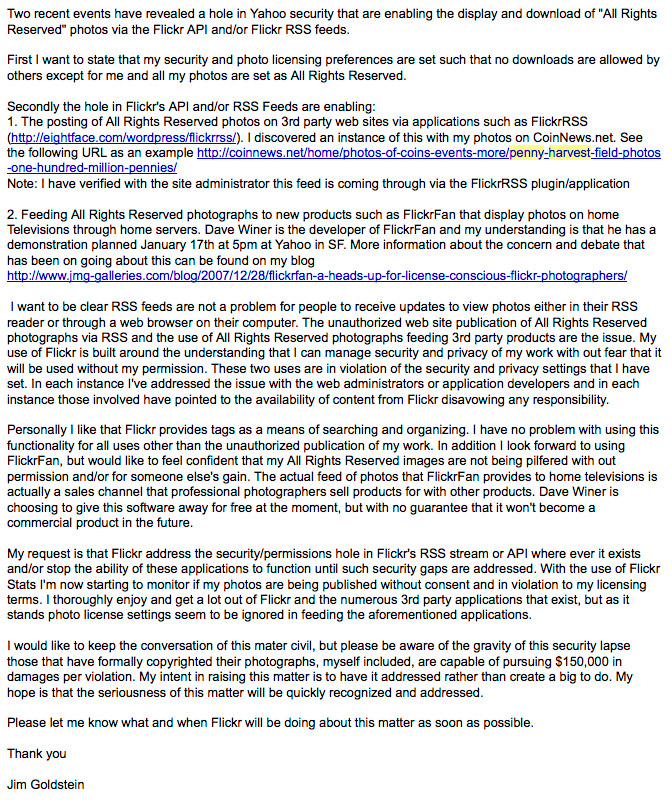
My Initial Letter to Flickr on the Matter
Click to Enlarge

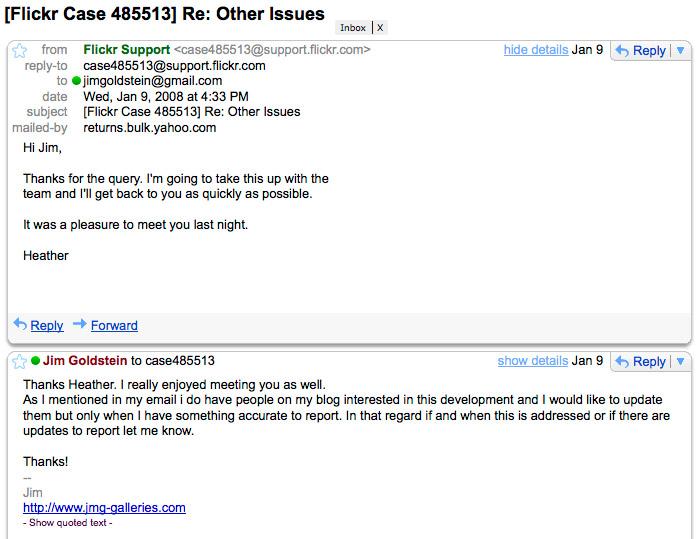
In early January I had the good fortune of taking part in a panel discussion, Media Web Meet Up III: The Producers, with Heather Champ who is the Community Manager at Flickr. I took the opportunity to let her know about this problem with either the Flickr API or how the API was being enforced. I was told that she’d get back to me as soon as possible. After a few polite email exchanges that spanned several months I never heard anything more from Heather on the matter.
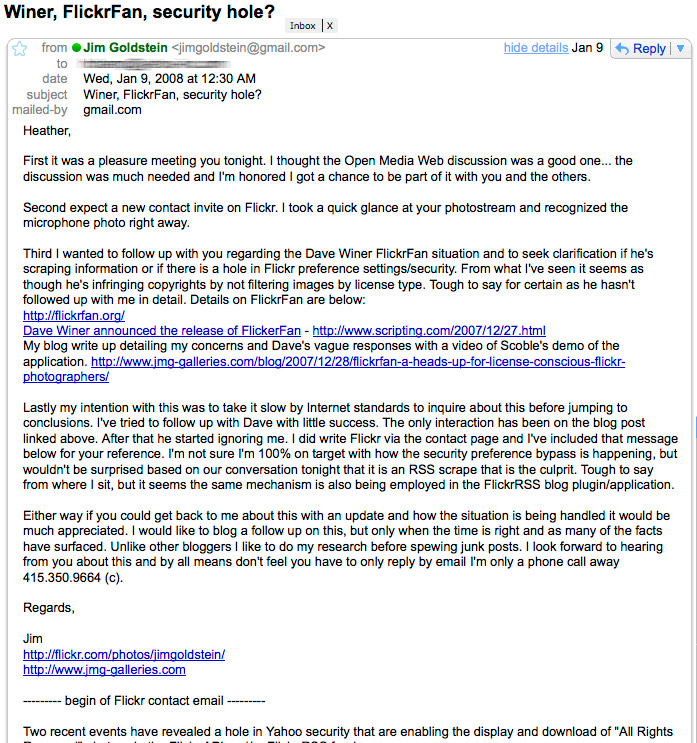
My Email to Heather Champ
Click to Enlarge
My Follow Up Email to Heather
Click to Enlarge

Then this weekend a Flickr contact (stargazer95050) let me know that my photo Out of the Gloom, which like all my photos has the “All Rights Reserved” license designation, was being sold as cell phone wall paper through MyxerTones.com. It turns out everyone’s Flickr photos were available for purchase through MyxerTones.com from July 3rd to July 5th, but Myxer disabled their Flickr integration after receiving numerous complaints.  Myk Willis of Myxer addressed the growing chorus of concerned Flickr photographers aware of their Flickr integration gone wrong this past Saturday apologizing and explaining the situation from his perspective.

This latest incident is by far the most egregious, as the use of photographs from Flickr were being sold with out the consent of a single photographer, all while photo licensing terms were programmatically ignored. I’m glad to see that Myxer took the proper steps to disable their Flickr integration, but this is the latest example of Flickr playing with fire. On some varying level it is easy to point the finger at Myxer, Dave Winer (author of FlickrFan), Eightface (the company behind FlickrRSS) or any other developer/company for improperly using the Flickr API, but I would argue that responsibility ultimately lies with Flickr.

Flickr controls their API and they control who uses their API. They issue API keys and supposedly monitor who they give these keys to whether companies like Myxer, independent software developers like Dave Winer or blog plugin developers like Eightface.  Flickr even goes so far as to provide Terms of Use for their API and the do their best to place responsibility of recognizing image licensing terms on the developers using the Flickr API.

Section 1a, sub-section ii
Comply with any requirements or restrictions imposed on usage of the photos by their respective owners. Remember, Flickr doesn’t own the images – Flickr users do. Although the Flickr APIs can be used to provide you with access to Flickr user photos, neither Flickr’s provision of the Flickr APIs to you nor your use of the Flickr APIs override the photo owners’ requirements and restrictions, which may include “all rights reserved” notices (attached to each photo by default when uploaded to Flickr), Creative Commons licenses or other terms and conditions that may be agreed upon between you and the owners. In ALL cases, you are solely responsible for making use of Flickr photos in compliance with the photo owners’ requirements or restrictions. If you use Flickr photos for a commercial purpose, the photos must be marked with a Creative Commons license that allows for such use, unless otherwise agreed upon between you and the owner. You can read more about this here: www.creativecommons.org or www.flickr.com/creativecommons.

So why blame Flickr? Regardless of Flickr’s terms with the developers utilizing their API I have an individual agreement, as every Flickr user does, with Flickr. That agreement states in section 9b of the Yahoo! Terms of Service

With respect to photos, graphics, audio or video you submit or make available for inclusion on publicly accessible areas of the Service other than Yahoo! Groups, the license to use, distribute, reproduce, modify, adapt, publicly perform and publicly display such Content on the Service solely for the purpose for which such Content was submitted or made available. This license exists only for as long as you elect to continue to include such Content on the Service and will terminate at the time you remove or Yahoo! removes such Content from the Service.

Note the bold text “solely for the purpose for which such Content was submitted or made available”. This is a slippery slope for Flickr and Yahoo as I’m uploading photos on Flickr to share with friends and the Flickr community. No where have I authorized an all encompassing distribution of my photography to third parties. Don’t get me wrong I’m not saying Flickr should shut down their API. I employ services that use Flickr’s API all the time with out problem. I authorize Moo to print cards with my photos, I authorize that my Flickr feed be picked up by Twitter and I authorize the use of my web site photo gallery to pull photos from Flickr. In each of these examples I have authorized how my photography is used in line with my licensing terms “All Rights Reserved”.

In fact if you look at your Flickr Account page in the Privacy & Permissions section you’ll find that you can authorize who downloads, prints, blogs, and searches your photos from Flickr. In my case I have opted to:

  • Let no one download my photography other than myself
  • Let no one print my photos other than myself
  • Make my photography available through public searches
  • Make my photography available to be blogged.

In the examples I’ve provided counter to my Privacy & Permissions settings …

  • Flickr RSS via the Flickr API has enabled others to blog my photography outside of the safeguards set in place through the “Blog This” button on each of my Flickr photo pages.
    Note: Flickr RSS is often used to provide image thumbnails on blogs and I have no problem with this, but medium size photos enable a resolution of display that is too great less a photographers consent.
  • FlickrFan via the Flickr API and RSS feeds has enabled others to download my photography when I have explicitly stated that no one should be able to download my photographs.
  • Mxyrtones/Myxer via the Flickr API has enabled a company to sell and make available downloads of my photography with out any authorization or agreement.

Taking myself and my communications with Flickr out of the equation… this is a known problem. Other application developers have become acutely aware of the problem of leveraging Flickr’s API while respecting the copyrights of photographers and the licensing terms they specify. As recently as March 2008 this very topic has been discussed in the Flickr API discussion forum (API usage and image copyright …).

When you read this previously noted thread you begin to enter the realm of finger pointing. Ask a photographer who they blame when their image is published inappropriately through a 3rd party application using Flickr’s API and they’ll blame the developer. Ask the developer in this situation and they’ll blame the photographer for making their photographs available. In fact most developers quite logically will state that photographers should turn off their Privacy & Permissions setting to make their photographs available through public searches. Unfortunately that only removes photographs from tag searches, but not searches across pools or sets. On the other hand the counter argument is, “Why should a photographer turn off the ability of their photographs to be searched because a developer isn’t capable of programming the proper logic to display photographs with the proper licensing restrictions?”

What both parties have missed to date is that Flickr is ultimately responsible to honor their agreement with individual photographers and to manage their API in such a fashion that the Privacy & Permissions settings specified by Flickr photographers are honored. I am personally disappointed that Heather Champ did not pursue looking into this in a more timely fashion.  I have gone above and beyond in giving her an opportunity to address my concerns privately through several email correspondences and a personal conversation. Seven months is a lifetime in this day and age of blogging on the Internet. That being said I don’t let developers off the hook either when it comes to responsibility of releasing applications using Flickrs’ API. Although Flickr has ultimate responsibility in managing their API and subscribers, developers have the responsibility to understand the law and not break it. When a photographer uploads photographs to Flickr they’re not signing away their rights to their work for 3rd party developers to do what they will with them.

If you’re a photographer who uses Flickr I would encourage you not to wait 7 months as I have before publicly talking about this. The only way Flickr is going to address and/or fix this problem is by Flickr members letting them know this situation is unacceptable.

Technorati Tags: , , , , , ,

Stay Connected with Jim
Join Me On Twitter Become a Fan on Facebook
Listen to EXIF & Beyond My Latest on YouTube

Related Posts

  • novasdtr
    Sounds like a class action suit
  • Guest
    I am going to stop using Flickr now as well as Facebook. I do not need more instances of corporate IP theft of my photography. Is Picassa any different?
  • You're still able to download [larger] image sizes via the API that image owners have chosen not to make available via via flickr's GUI interface.
  • Thank you, Dave.
  • Very interesting string here regarding Flickr image usage rights. In noticing that the feedback went quiet nearly a year ago, does anyone have the latest status update on this issue? For the record, I have been a very active Flickr member for 5+ years. Cheers!
  • Thank you Juha for pointing that out. It was a personal choice on my end. Now I must connect with you and discuss hiking in Finland!

    Thank you for taking time to respond.

    Liisa~
  • While this is something that everyone should be aware, I would like to point out that Jim has not left flickr for it. He still has pro account and is posting new photographs on regular basis.
  • Hi Jim.

    Thank you so much for taking the time to share your Flickr experience with all. After reading this post and the comments, I promptly deleted all of my images and my Flickr account. After notifying Flickr why I was terminating my account, of course.

    I wish you continued success in the New Year.

    Sincerely,

    Liisa Roberts
  • Lee Wolfe
    Thanks for the article. Up until now I've always uploaded the highest resolution and largest sized photos to my flickr account. Looks like from now on I'll have to save them as low quality jpegs not suitable for commercial use as well as add watermarks.

    I agree that it would be very simple to add licensing as a condition for software programmers. Or even just require a rights reserved tag for photos unavailable for commercial use. In the same way the program pulls photos by tags it could eliminate potential photos by tags.

    And to think they charge for a pro account and pay you nothing when they sell your content to third parties.
  • I agree with Mark Goodwin. I disagree with Sean McGee. I am a hobbyist photographer, a semi-pro photog and starving artist who had to get a daygig because art, music, photography, none of it is rewarded either commensurately or consistently. I agree that you have to learn to love your job, and I've succeeded at that no matter what the occupation is/was. The reason I have to work a less artistically rewarding job is because of attitudes like Sean's. The stuff Sean was spouting was pure bovine scat. Many members of my family are authors, composers, photographers, cinematographers and the like. I am an inventor of new Anti-Piracy Technology with 30+ years in engineering - computers, audio, and video, analog and digital.

    I am of the opinion that flickr actually doesn't want to do anything about this issue, and as an engineer with 30+ years in technology and computing, I know it'd be a fairly simple matter to make this right if Flickr wanted to do so.

    Good luck to all of you. Happy Holidays and a much better 2009.
  • andrew
    Ottmar Bierwagen -- If you sign up on flickr, you can send any photographer an email. When viewing someone's profile, there is an option to "Send Flickrmail".
  • Ottmar Bierwagen
    I understand your complaints as a former photographer and now stock agency owner (must be crazy these days!)I've seen images on flickr I'd like to purchase but many downloads don't have a way of making contact. You lose and we lose a sale. Please make your contact available and we share any sales 50/50.
  • Hey Jim:

    Long time no talk... I was pleased to find this article. Very thorough, thanks for spending the time to write it.

    I haven't read all the comments, so this may have been mentioned already, but I find it interesting that flickr won't provide an optional feature to automatically watermark images as you upload them... my impression is that they are well aware of what's going on and want to keep it that way.

    Manuel
  • thanks so much for this info. I had no idea. Looks like i will either discontinue posting to flickr or all my photos will be private...friends only viewing.
  • Pam
    So stop complaining and build your own flash based website to show your work instead of throwing it on a social networking platform? Add a copyright or make them available to only Flickr users that you want to see them and are sure that won't take them.

    Something people have to realize is that most people are not educated on what is stealing and what is not, so if your photos end up on some forum because you added them with no added privacy pictures, these are people who probably don't understand copyright infringement, and just like your work.

    So if you don't want your photos our there in an easy to steal setting how about putting them somewhere else, or adding some privacy settings.

    Also it wouldn't have been hard for the coin site to also pull, a refer link to where the picture actually came from. That is responsible webmastering. Always linking back.
  • CN:Photography
    This is just ridiculous.
    More and more every day I lose faith in the common being as I am stolen from or witness such acts.
    I for one am moving my stuff to SMUG-Mug.
  • This is one more reason why I've always built my own galleries and will never use flickr. I don't want to trust any of my images to someone else.
  • Derek, I would like to think my work is pretty good and I shoot professionally but, contrary to what you say:

    "If you cannot afford a copyright attorney then your work must not be as great as you think that it is and Flickr spreading it around the world might actually be a benefit to you."

    ....Flickr was basically enbaling violations of my copyright almost every week. That's expensive to chase even if one's work is pulling in big money. Checked how much copyright lawyers earn recently?
  • Derek
    I don't make a living taking photos of my granddaughter so it is people like me, I suppose, who will remain with Flickr. If, my living depended upon my photos I would legally enforce my copyrights. Someone mentioned "somehow" holding Flickr accountable. That is simple. Hire a copyright infringement attorney and go after them every time they use your material without your permission. If you cannot afford a copyright attorney then your work must not be as great as you think that it is and Flickr spreading it around the world might actually be a benefit to you.
  • All Flickr users should do something to get yahoo/flickr answerable.
  • @Sean

    Sean as far as I can see you are now getting down to conceptual semantics and I really don't want to continue down that road.
    My argument is simple and straightforward. You say QUOTE:Art is different from other forms of “work.” I believe that the talent of “art” is a gift. You receive free, give free.
    It may well be your 'belief' and what I am putting to you is that your belief is incorrect! I am trying to explain to you that so called 'gifted' people have to work very hard to become recognised as a talented artiste. So, when the results of their work is put on display - wherever - does anyone have the right to say, " hay I like what you have done I am going to take that and use it without any recompense to you because...well it's art init? And art should be free man, and I am now going to bootleg the outcome of your art/talent and make some money. Thank you very much, keep it coming".

    Sorry Sean, all that " music wants to free" is just not an argument, and people who are positions of employment such as yourself should not be preaching "art should be free" but standing up for the artistes, whose work you buy for your magazines, and assisting them to achieve a greater audience and wider acceptance.

    Regards

    Mark
  • @Mark & Alfie: The only reason I mentioned that I was a pianist and Art Director is because my credentials were called into question.

    QUOTE: "You are a) obviously not an artiste, talented or otherwise and b) don’t earn your living and put the food on the table for your family from your art."

    Now, what do you think about this hypothetical situation? Say I believe something that you think is faulty, and person "B" tries to show their viewpoint on the matter to me. What would you think of me if I told them to eat sod, and that they have no right to be preaching their BS "gospel"? I'd be a pretty big douchebag, wouldn't I? So, why say this: "I don’t care one way or another about your ‘beliefs’ just don’t go around preaching your gospel according to Hawk BS to the rest of us." That's a pretty closed-minded thing to say. A little respect, please. When was I disrespectful to anyone's opinions? The only thing I offered was a differing point of view.
  • You make some very valid points in your post, and as a Flickr user (Lynchburgvirginia). I have set my permissions the same as yours. As a pro member of Flickr, a service that I pay for, I would expect Flickr to provide protection for us against the illegal use of our photos.

    And I agree that developers need to respect the all reserved rights. In any case, this looks like grounds for a joint action lawsuit.

    Thanks for the post, and I may link to your post in a future article on my blog.
    Sincerely
    Bob Miller
  • Oh! I wish I could have said that!

    Thanks Alfie, I couldn't agree more.

    Moreover Sean, your point about enjoying your work and working at the thing you love etc. I started playing drums with a passion at age 11-pre Elvis and R & R. I practised 3-5 hours a day, by age 14 I was working semi-pro, and 18 I was pro. I continued in this career until I was well into my 30's and married with children. Let me tell you truthfully and honestly, that dream job ain't such a dream when you are leaving your family to travel 1000,s of miles away and to be living there for three months, only to arrive back home for three days before flying off to another continent! This is the life, if you are a successful professional musician, the more time you spend with your family, the less money you are earning to support them. If you believe that earning a living from doing something you love is a dream, then you are more naive that I thought. What do you think Vincent Van Gogh would have said way back when, if you had said to him " hey Vinnie you are one lucky sob man, wow painting for a living, that must be wonderful...hope the ear gets better soon!"

    I don't care one way or another about your 'beliefs' just don't go around preaching your gospel according to Hawk BS to the rest of us.

    I live in the real world and have done for 67 years. During that time I have had a number of successful careers (if you count earning a good living from your career as successful) which includes being a professional musician, being a marketing manager and clinician for an international company (CBS), running a successful management & training consultancy and, the occasional photographer. I learnt to love every one, because if you are working in a job that you don't love, you will not be giving the best of yourself, to your employer or your customers, and it's my experience that the people who find themselves in those so called 'dead-end' jobs are continually looking for a different job, and it is those people who say that the 'pro' is lucky to be doing something he/she loves!

    Gift, schmift! you say you are classically trained pianist, if it was a 'gift' surely you could do it straight away, why did you have to spend all that money on training for?
    I don't know about that gift BS, all I know is that all the professional musicians who were so-called 'gifted' that I have worked with both in the UK, Europe and the States, were still practising daily when they well into the 60's and occasionally 70's,so they could maintain their skill level.

    In the words of the late Mark McCormick when confronted by a young and hungry entrepreneur who said that he "admired Mark, but he had to agree that he had been lucky". And McCormick's reply was, "Yes you are right, I have been lucky, and you know something, the harder I work, the luckier I get". Or put another way, yes I am gifted and the more I practise my profession, the more gifted I become.

    Regards

    Mark
  • Sean. If you were making your living as a pianist and someone recorded your concert, released it and made money from it, how would that make you feel? That's how I feel when people do it with my work without asking. Do the magazines you work for allow people to re-publish the articles without permission, for free? Would the writers get upset if someone re-published an article they had written and attributed authorship to themselves rather than the creator? All these things have happened to me.

    I agree, being creative is a gift, just like being good with numbers might also be a gift or having the aptitude to be a pilot. Do accountants and airline pilots have this philanthropic attitude to life that you believe is the way artists should conduct themselves? I think not.

    My being good at photography is, whilst part gift, part investment too. After leaving the army, I spent three years at art college. Using film and paper was not cheap and I made a considerable investment in materials and equipment to turn my skills into something that could be a career for me. As it happened I ended up in the music business and then had my own design business for some years but now I am finally pursuing a career as a photographer.

    I have to make a living. Despite copyright and IP having been conceived during pre-internet times and needing an update, some way needs to exist to make sure that people who create can also make a living from their skills.

    The whole concept of creation and ownership may have changed with the increase in digital technology and the arrival of the internet. But the money-free, barter and share economy is fraught with difficulties, although I do use it where I can; designing and hosting a website for free for my Japanese teacher, for example.

    I think you may have reading too much Tom Hawk, with his 'my photos are like birds.. I let them go to be freely enjoyed' bullshit. The man owns Zoomr so he has his own photographic business empire and taking photos for him seems only to be a numbers game: his mission seeming to be more one of trying to hit the 1,000,000 published photos mark than anything else. He has some interesting things to say but his opinions on ownership of photos and about giving them all away for free are only practical when you have money coming in from somewhere else, as also seems to be the situation with yourself: proper job, hobby of photography.

    Photography is not my hobby. It's my work. Just cos I happen to have a job that other people are envious of [being something I can enjoy as well] do you honestly believe that just because I have this gift, I should give it away?

    Utter rubbish in my opinion. Everyone has gifts.

    If your 'art is free' model is to be pursued, then everyone needs to join in. If my gift of being creative is something people should freely enjoy, then maybe the gift of being able to bake bread is something my local baker should share with me for free; the gift of being able to cook a superb meal is something my local restaurant should give me back for free... and so on, and so on.
  • It's like Thomas Hawk was reading my mind this morning: http://thomashawk.com/2008/08/associazione-arte...

    Key Quote: "Art, like music, wants to be free."
  • Just because I have an opinion about art, does not mean that I won't capitalize on the fact that I can get paid for it.

    I'm not a lawyer, but AM a classically trained pianist, a hit-and-miss amateur photographer.

    I make my living as an ART director for 3 quarterly magazines in Texas.

    My opinions, however, are just that...my opinions. What did I say? "I believe that the talent of “art” is a gift. You receive free, give free." Notice that phrase, "I believe..." It doesn't mean that's an ideal for everyone...it means that that's what I wish the world could be like. As long as it keeps paying the bills, I'm not going to change things. HOWEVER, if someone steals a photo or graphic of mine for their use, I have no problem with that. Just give a little credit my way and I'm fine with that.

    And, yes, Art IS different from other forms of "work." How? Usually, the person performing the art ENJOYS what they do. That's not work...that's living a dream.
  • @Sean McGee.

    What a load of old tosh! You are a) obviously not an artiste, talented or otherwise and b) don't earn your living and put the food on the table for your family from your art.
    Non artistic/talented people have taken what is not theirs to take for 100's of years. This is why to this day anywhere in the world you can find very talented musicians, painters, dancers etc who are living in poverty. Why don't you go and tell them that the talent they have been "Given Free" is not theirs to keep! Never mind that have been practising 8 hours a day to perfect the 'free gift'.

    You gotta be a Lawyer!

    Regards

    Mark - Wales UK
  • @pds: There is no such legal term as "forfeiting a copyright claim." There is such a term as "fair use", but that's not the issue here.

    If you restored a classic Mustang, and were to show it off at a neighborhood car show...since you are sharing your work publicly, are you "forfeiting" your legal claim to ownership? No...of course not.

    There is no legal precedent to make a claim that because someone publicly displayed a piece of art, that they forfeit any rights they had pertaining to it. Does that sound just to you?

    Now, when you use the Flickr Service, the photos you upload are licensed for Flickr to use in their application. Any other use could be considered a copyright violation.

    But I don't care...steal my photos. I look forward to the day where copyright is nonexistent.

    Art is different from other forms of "work." I believe that the talent of "art" is a gift. You receive free, give free.
  • Steve
    Are you a lawyer?

    The topic here wasn't people using the API, but Flickr having the API such that its claims to preserve copyright if that is so indicated in ones' personal settings, was a false claim.
  • pds
    By not opting out of public sharing you are indeed forfeiting the copyright you placed on the image. In fact if you try to uphold your copyright of an image.. then share it on flickr, then refuse to make it private.. then complain that somebody is using the stream in accordance with FlickR guidelines, I'm pretty sure the web provider (who uses the api in the manner intended eg: RSS feed with thumbnail only that links back to flickr for the full size image and displays the owner's name prominently and links the name back to the owner's flickr page and does not modifify the stream in any way, nor claim ownership nor sell the image), well, that person can go after the copyright holder with a fraud by deception case.. In other words, I would claim that the person who took the photo posted it on FlickR, refused to use the make private feature in the sole attempt to seek frivilous copyright claims.

    Like I said, I don't condone anything beyond the republishing of API XML, but I get constant "You are using my photo illegally" and after politely advising people to make their photos public, they threaten lawsuits. Read your terms of service before you complain. Your TOS says that your images will be distributed publicly unless you turn it off.

    In fact, when people repub xml feeds, they are promoting your photos and your flickr profile free of charge. It's a win-win situation for the photographer and the web publisher.

    I just don't see why you complain about that part. Again, don't QQ to me about full size images or people claiming their own copyrights on your work. My complaint is with photographers' gripes on fair and legal use of the API according to the Yahoo and FlickR terms of service.
  • I found some guy using a Flickr API to promote his vacation rental home business. He was pulling Flickr photos that had a "Crater Lake" tag and the photos (if clicked on) did route the viewer to Flickr. However, the text of his website implied that the photos were views that people who rented his cabins would see (a load of $%@#!)

    Flickr should be careful.

    eBay had a similar attitude about infringing on intellectual property rights. Their position was "Hey, if you tell us there is an item for sale which infringes on your rights, you can tell us and we'll remove it, but we're not responsible for the infringment.

    I believe a Federal court just disagreed with them stating that your can't knowing facilitate the infringement or be the middle man.

    Seems like the same law firm which was successful against eBay might be interested in chatting with Flickr.
  • Dave is right...just because you upload a photo to a photo sharing site does not mean you forfeit any copyright you may want to claim. However, it does mean that you shouldn't be surprised when you find your photos elsewhere on the net.

    (I am shocked, shocked to find my photos on the internet!)

    Now, as to the issue of carrying feeds on a website or not, here are some facts. Even though a website may display the pictures, and even though that website's visitors might be able to download those pictures, if the photos are never hosted on the website in question, and stay on flickr's servers, there is no copyright violation by anyone but the users of the site...not the site itself.

    Now, if the site uses the RSS feeds to download Flickr images to the site's individual servers, of course this would be wrong and a legitimate copyright violation claim.

    Should Flickr police copyright issues related to abuses of it's API? It's a good question. But, I believe it is the responsibility of the copyright holder to either police it him or herself, or appoint a representative to do so.

    In an ideal virtual world, you could go to a website, type in the file name, and find every place your files have been illegally copied to. But this isn't an ideal world, virtual or not.

    You've heard the saying, every cloud has a silver lining? Well, I say, finding a silver lining doesn't mean there's not going to be a storm. Flickr's a great website for what it is. But there are negatives to using it.

    If those negatives are bothersome enough to cause you to feel outrage, then why continue using something that causes those feelings within you? It would be illogical to do so. Just ask Spock.
  • "it’s flickr’s fault if they are streamed to other sites"

    Er no. If other sites are reproducing images from flickr, it those sites who are at fault. Just because there is an API and XML feeds does not mean that you can do whatever you want with the content they reference.

    "you are also forfieting your copyright"

    No, that's not legally [or morally] true, you can decide to give up your copyright, or to license images under whatever terms you wish, but making a thumbnail available does not ipso facto "forfeit" any image rights you have.

    "we carry FlickR xml feeds on our site"
    And which site would this be???
  • @ pds - By your quote "I’m tired of people complaining copyright infringement just because we carry FlickR xml feeds on our site." am I to understand that you are representing FlickR with your comment? Hmmm .. perhaps it's just me, but you came of very unprofessional without concern for the people who send you home a paycheck ... US!
  • BIB
    pds:

    Read up on copyright law and take a look at the creative commons license.
  • Jim
    @pds I think you're losing track of my point. If Flickr claims to implement security features those security features should actually work. If you read the post in full and the comments you'll find that Flickr is not completely baked in this area. If I were averse to sharing photos I wouldn't have them at Flickr. I just expect Flickr to abide by the terms and features they hold themselves and their users to. For the record I host my photos at Flickr as well as other services for professional photographers. Thanks for the comment.
  • pds
    FlickR is not a professional photography service. It is a photo SHARING service. You post photos to share knowing full well that there is an API .. AND there is option to opt out of the API.

    To sit here and say "I want my photos to be public, and don't want to make them private, but it's flickr's fault if they are streamed to other sites" is ludicrious. You should just stop whining about FlickR and pay for a real professional photography service that watermarks your images and charges for downloads.

    I'm tired of people complaining copyright infringement just because we carry FlickR xml feeds on our site. I do understand your frustration about high quality images being stolen, which is wrong, but the feeds are free to use as is and by not opting out of the XML/API, you are also forfieting your copyright on the thumbnail images for use in RSS feeds.
  • Dan Thomson
    Right click is moot. Forget the api. Upload only small, low res photos. Everything is stealable even if permissions are set for only you to download.

    A simple knowledge of html is all that is required.. view the html source... search for the term... jpg and one them will be your photo... copy and paste into the browser the prefix before it.. voila..
    I stopped posting anything other than small 4 inch wide photos on Flickr for that reason...

    Don't kid yourself.. if it is on the net.. it is there for the taking. Play it safe if you value your work
  • Thanks for this post, I hope it makes people more aware of potential image theft issues when using online services such as flickr. I wonder what percentage of flickr users are aware that all of their images were being sold by the wall paper web site???
  • Stashy took themselves off the web. a visit to stashy.com gives this message:
    Hi folks, it's time to say goodbye.

    Yesterday (16.07.2008) we understood that there are some images posted on the site without the owners' permission. So we removed them immediately. And then we started thinking how many other copyrighted images might have been posted on the site. Stashy is a community powered site and our small team of two students cannot control and support it 24/7. We created Stashy to bring joy and fun to the people, not to deal with guys that post copyrighted stuff. And since the site started to fail in its mission and we do not have any profit from it, we decided to shut it down.

    We apologize to the real owners of the copyrighted images. Please don't hate Stashy, hate their posters.


    To all Stashy fans and users: we want to say that we are sorry that we are shutting down our baby. We love you guys!!!

    Have fun and enjoy the summer :)

    The Stashy Team
  • Stashy.com went off the air for a while yesterday, with a message that their hosting account had been suspended. It's back up now but with all the Flickr content removed.
  • Great how Flickr makes a site that volumises the way pics can be hoovered up and re-distributed, waves some illusion of privacy and permissions in front of you when you join [so that the onus is on you to protect yourself] and then calmly backs away from every infringement that occurs, despite the fact that it is misuse of either the API or RSS feeds from their site that is causing most of the infringements.
  • Yes, I got that.....

    ""Thank you for contacting Flickr Customer Care.

    I'm sorry, but Flickr is unable to take action when copyright infringement occurs on a site other than Flickr.com. If the photos are hosted on a site other than Flickr.com, you would need to contact the site in question or the site's hosting company to get the photos taken down.""

    ...when I had pics stolen before.

    Interesting, Jim, that in the help forums on Flickr I am being blamed/flamed for feeding you the 'misinformation' about myxer selling photos.

    People seem to miss the point that a site, as myxer was/is, who sells advertising space and then has free content onboard is using that free content to attract traffic, to sell advertising.
  • 'view source' on the stashy page provides a link to the original flickr page.

    The fact that stashy stores copies of 'all rights reserved' images that were posted to flickr on their servers looks like pretty blatant infringement. Someone does appear to be systematically harvesting images from Explore.

    Flickr's response to some reported concerns [e.g. http://www.flickr.com/groups/strobist/discuss/7... is not particularly helpful.
  • PS - that Stashy website is THE WORST. I tried to write to their 'abuse' e-mail to report the problem and funnily enough the mail was returned as undeliverable. That is when I realized the link they set up goes to 'abuse@stahy.com' instead of 'abuse@stashy.com' -- I suggest flooding their real e-mail addresses with complaints galore.

    They are hosting tons of the Flickr photos from the static.flickr.com pages - which means even a well-meaning person who came across them could NEVER figure out who the photographer was, nor ask them permission before downloading and re-using the image on a website anywhere. The number of photos available from Flickr's static pages (search Stashy on 'Flickr') is astounding. DISGUSTING. Does anyone know if legal action is being taken against Stashy yet?
  • As a programmer, I can promise you that it IS 100% possible to alter the Flickr API so that it CANNOT ever be possible to take images that were on the site marked as copyright protected - they could close that hole so easily it's not even funny by just making sure the API, no matter how it is called, always excludes those types of images.

    But instead, Flickr makes it a 'choice' for the adopting 3rd party programmer to have to 'know' to 'decide' and code in the logic to check to see if a photo is copywritten before it scoops it up - if they don't do that, it gets everything. If this is the case, then that is just plain illegal since Flickr is NOT honoring their promise that they 'claim' to give us as a service which we paid for when we set up our privacy settings (eg I set mine to NOT make my photos searchable by the API -- I didn't think this choice was actually left up to the website who IMPLEMENTED the API to 'understand' and code and that their API was wide open - I thought that Flickr would not even allow this OPTION to gather photos so-marked on their API at all!)

    It is just plain copyright theft by Flickr programmers, to be honest - they should not make photos available via their public API when photographers on their site have CLEARLY marked those as 'off limits'.

    I don't want to make my photos private to accomplish this task - what is the point of being on a photo sharing website where one of the best things about it is the ability to get commentary on your photography if you do that? That was not the Flickr promise.

    Certainly I want individual people esp Flickr members to see my photos and to comment or to ask me if they would like a copy for their own use. But I certainly don't want them available for mass downloads by pirating websites and I don't want them 'API retrievable' and -- any idiot - even an idiot working for Yahoo - KNOWS this by the way I set my Flickr privacy and copyright settings that THEY designed to 'assure me' that my wishes would be respected 'to the best of their abilities' -- then they go out and design an API that BLATENTLY ignores those precepts which THEY set up on their own website.

    They have made this API illegally open ON PURPOSE and I belive this is negligent at best, criminal conspiracy at worst - was Flickr conspiring with 3rd party site developers to further profit from the photographers who pay to use their site via sales of their API keys? Racketeering charges anyone ? Where is a good fly by night out for a buck class action lawsuit attorney when you need one? Where are the Flickr insiders to send some journalist a few juicy internal memos to blow this whole thing wide open?

    Good bye flickrHOO!
  • Andrew
    This site recently came to my attention: http://www.stashy.com/

    They are actually hosting images stolen from flickr.
  • BIB
    It's so laughable they even call it a 'pro' account!!! That's it. Flickr's over for me too and I don't think I'll be re-newing my 'pro' account. Thanks for posting this.
  • Pat
    Well I am suspecting this may be a little bit of a tempest in the teapot.

    If you want to get a better reaction from Flickr -- if anyone is still there -- what you really should be doing is asking that by *default* the public images only be displayed that have a CC or PD license. As an API developer, I expect that by default things behave well. (that is what defaults are supposed to be -- the "best way").

    But still people... realize that Flickr is not in the business of marketing photos. So they have very little incentive to worry about the 'professional' photographer. Their prime market is the point-and-shoot crowd. It's a waste of time to get mad at Flickr for not being what they don't want to be. A better reaction would be to go some place that is more set up to treat photos as a commodity to be sold.

    Anyhow with all the turmoil at Yahoo! don't expect a quick reaction.
  • There's an old saying (well, old by Internet standards) that technical solutions aren't very for solving social problems.

    Copyright matters, I think (there are folks who disagree).

    As others have pointed out (though I get the impression that not everyone is quite understanding the message), if a user can see an image, then they _have_ the image and they can copy the image. (If nothing else, they can pluck it out of their browser's cache.) As I've pointed out (at least I meant to), no security, including Digital Restrictions Management (DRM), is bulletproof; so even if you try to force users to view your photos in a plug-in you supply that enforces DRM, as long as they have control over their own computers, someone will be able to break it.

    So here's why I don't worry about disabling right-click: it only really inconveniences the folks who want to do 'fair use' stuff with my photos anyhow. Anybody else is either never going to try to right-click-save in the first place, or is going to be more motivated than the casual fair-use user, and will work around anti-right-click measures as a matter of _routine_. I won't say that disabling right-click lacks any value at all; I can see a naive user running into it and perceiving it as a _reminder_ that folks care about copyright, so it might stop some abuses-through-ignorance (or lack-of-care), even though it will barely even slow down anyone who actually intends to infringe. Personally, crippling right-click isn't high on my list of priorities.

    (For the folks who do care a lot about that, accept that you're not going to be able to stop anybody, but you might make a few people slow down enough to think, "Oh, the artist doesn't want me to do that," and maybe consider the reasons for that.)

    Similarly, I cannot see a way for Flickr to absolutely enforce license restrictions on photos made accessible via their API, except by making any rights-restricted images completely invisible via the API. Anyone who wants the image badly enough will either break whatever safeguards Flickr imposes or resort to screen-scraping.

    What I _do_ see that Flickr should be doing, is making it _as_easy_as_possible_to_comply_ with license terms, and maybe a bit harder for their API users to screw up through 'mere' inattention. (Scare quotes because unlike someone who simply doesn't know better, lack of attention to license terms by someone who does know better but just doesn't care is a bit more sinister.)

    Is there a way to tell the API, "Only give me images with licenses that include these privileges"? (It looks like there is on the flickr.photos.search call, as an optional parameter -- is that how most API users retrieve photos?) On retieval calls where there isn't, there should be; if it's already there, perhaps the default can be changed so that an extra step is required to grab images not already CC-licensed?

    As always, a balance will need to be struck between security and ease of use. Unfortunately, whether the balance one picxs is 'correct' is not always obvious. Making the default acceptable license list on an API request be some subest of CC licenses instead of "any", and making developers fill in that parameter to get non-CC or CC-noncommercial images would, IMNSHO, go a long way toward that. (If nothing else, it would take away the "I didn't realize I was snarfing up non-free images as well," and "I can't help it, the API gives me everything" excuses! Filling in that argument would make the request for rights-reserved images explicit; no ignorance excuse.)

    But ultimately, even after we badger Flickr into making it harder to do the wrong thing accidentally, convincing users that the safeguards are there as reminders and to keep them from doing something they shouldn't want to do, rather than mere annoyances to learn ways around and then ignore, is a social problem more than a technical one. So ... educate, at every reasonable opportunity.
  • @Pat - yes, SmuGmug have basically done what Flickr did with their 'spaceball.gif' transparent overlay. Using Firefox's ad blocking tool can open up images that the transparent gif is designed to stop people accessing. Google 'spaceball.gif' and you will find a whole bunch of folk cracking that method of protection.

    I also agree that it shouldnt really be your job to enforce the Flickr contract with photographers, just to follow ALL the rules of the API, whicha lot of third-parties dont; such as leaving out the licence code. But, yes, Flickr should be doing a whole lot more to keep their API from being misused although third-parties do have a responsibility in this too; i.e. not to misuse it. You may not be but plenty of them are.
  • Pat
    @Krista Neber -- you are a little too proud of the way you have "disabled" right-click. Admittedly it will stop some people. It took me about 5 seconds to figure out what you had done and download a picture from your website. Keep trying. You are doing the same thing Smugmug does. I thought they were going to be smarter but apparently not.

    @Joy -- "right-click" is built into the browser. Reality is that if it shows up on a screen it can be copied. Get over it.

    To others in general -- The biggest travesty about this is that as an API developer I should not have to make sure that I enforce Flickr's contract with YOU. I expect Flickr to do their job and filter from my application any images that my application should not access.

    @Tupart -- It is really pretty easy. Any number of developer tools available for Firefox and IE let you see the image. Basically what Smugmug did was make the image a "background image". Pretty weak protection -- if anyone was counting on that .. forget it.
  • I've written up a long response on the technical details of this issue. You can read it at my blog, at:

    How Flickr could make the world a better place for copyright

    An excerpt:


    Flickr has come under fire recently for not enforcing licensing terms on images accessed through their application programmer’s interface (API) and syndication feeds. Flickr could rectify this situation, and reduce the confusion and misinformed reaction, by making a few simple technical changes to its API, and minimally reaching out to its community of photographers, viewers, and developers.
  • Joy Elizabeth

    I could not agree with you more. I work for a photo website (www.photrade.com) and we discovered this need and have been working to build a site to help photographers share, protect and make money from their photos. We are working on creating innovative technologies that will help keep your photos safe. To date we have launched custom watermarking (automatic - you set the watermark up once) and we disable right-clicking (you get a blank image). We will be releasing an entire protection suite over the next few months - this is only the first step.

    We believe that you should be able to share your photos on your terms, so we also allow you to sell digital rights and prints of your image. Our goal is to give image users a simple solution to purchase images and generate awareness around image theft.

    We are currently in a closed beta - if any of you are interested in checking us out send me an email (krista at photrade dot com) and I would be happy to send you an invite for our site.

    We would love to hear your feedback on how we can create a photo site that would really meet your needs.

    - Krista (VP Marketing, Photrade)
  • Thanks everyone for your input ... BOTTOMLINE, I feel Flickr should NOT allow right/click copy. PERIOD! Same as many other photo websites don't allow it by alarming a error message of sorts stating “THESE PHOTOS ARE COPYRIGHTED BY THEIR RESPECTIVE OWNERS. ALL RIGHTS RESERVED. UNAUTHORIZED USE PROHIBITED!” As for Screen Prints, I clearly understand that too, is freely available for anyone to do, but I feel any attempt by a photo website to protect the photos that are entrusted on its site by its customers, either PUBLIC or PRIVATE, is another step towards making the customer feel secure & one less way for a pervert or thief to quickly & easily take from a website to store on ones own computer. As for photos on the "open" Internet, free game right click/copy all you want ... it's a great feature! Sure, I understand that the ONLY real security I have in preventing theft is by not having my photos out there for public display except by those I personally allow by being F&F, but when I placed my photos on Flickr, I thought based on the permissions offered, referring to the download option, that lead me to believe that right click/copy would NOT be possible & it wasn't until recently, that I became aware of the Screen Print ability where that was the determining factor that made me decide to go F&F on nearly all my kids photos ... but still, most all my other photos, are available to the world to steal, which one may do if they don't have a conscience & which they can easily get away with for what are the odds of someone getting caught? Few & far between, we all know. So I've come to realize, what purpose does posting photos on a PUBLIC website really serve a photographer in a positive way? Exposure, as a gallery does, right? But in a gallery, ones work cannot be duplicated by right click copy or Screen print! PHOTO WEBSITES NEED TO DO MORE TO SECURE THE RIGHTS OF PHOTOGRAPHERS!
  • Joy, go ahead and save the picture. Then look at it. You'll save the spaceball.gif transparent layer that protects the image. But, as Sean McGee and others have put it, all protection schemes are extremely easy to circumvent by someone willing.
  • Joy...as an alternative, even if Right Click/Save Picture As doesn't work, you can press the "Print Screen" button, and paste into Photoshop or any other photo editing program.

    So, no matter what Flickr does, as long as your photos are uploaded there or anywhere else on the internet, people can copy them without your permission. Just press "Print Screen."
  • Well Dave, I find that just ODD! Since our last exchange, I asked a few others to do the same ... some were contacts, some not, & they all were ALL able to SAVE PICTURE AS, just as I am on any photo I see in Flickr. Right click/copy doesn't appear in OUR cases to have thing to do with PRIVACY ... it seems it's a given ... anyone but you are able to. Hmmm ....
  • When I right click on your photos I can't save the image. For your contacts etc. it would obviously depend on how their privacy settings are configured. Given that the default/recommended account setting allows anyone to download pictures this isn't surprising.
  • Thank you Dave for your opinion ... I'm sure it's based on your own personal experience, but I have experienced differently, for I can right click/copy on ANY photo whether my contact or not! So let's try this ... go ahead & give one of my photos a right click/copy & see what happens!
  • Joy - you are ALWAYS able to right click and save YOUR pictures - if your setting is 'Only You' then no-one else will be able to right click and save.
  • Thanks for the advice ... it already is! Unless it's NOT working? That still doesn't eliminate the possibility for one to right click/copy.
  • Joy - go to
    http://www.flickr.com/account/prefs/downloads/
    and set the 'Who can download your stuff' setting to 'Only you'.
  • Thank you for the link JUAG! It's nice to have some clarity on what exactly happened! I still don't like that Flickr allows the right click/copy feature to work. SmugMug doesn't, as a few other photo sites don't either! Why can't Flickr disable that ability & have a alert as SmugMug does ... "THESE PHOTOS ARE COPYRIGHTED BY THEIR RESPECTIVE OWNERS. ALL RIGHTS RESERVED. UNAUTHORIZED USE PROHIBITED!" Sure one could still do a Screen Print, but shouldn't Flickr do ALL that it can towards assisting it's customers! I'm sick & tired over fighting these Orkut brats stealing my photos by right click/copy!
  • JAUG
    http://mykwillis.wordpress.com/2008/07/09/flick...

    not sure if this link had been posted here.. if so - here it is aagain...
  • APJones
    Is there any way of tracing ones photos ?
    i.e. if any of my photos have been taken from the flickr site and used for any other purpose, how can I tell ?

    Hasn't every download got a unique reference number that is attached to the file , like every PC adress, that is traceable ?

    Secretly I'd be rather pleased if I found out that a photo of mine was deemed good enough to be used in mass production. But I'd want some sort of recompense if somebody else was making money out of my work. But how do I find out ?

    I'm an engineer not a computer or copyright lawyer so forgive me if my questions are niaive.
  • Just to clarify that in this recent myxer case, the download direct to mobile phones was pulling the image straight from a myxer.com server. They were resizing the image, piping it directly from their servers to the phones of customers. That would suggest a violation of the API as the images actually being delivered to phones were coming direct from myxer.com not from Flickr.
  • Being a frequent, hours/per/day internet user I learned something a long time ago. If you don't want something of yours to be used or abused, don't upload it to the internet.

    I read your post. It may be your opinion that the API violates your individual TOS...however that's just what it is...an opinion. And you know what they say about opinions...they're like @$$holes...everyone has one and they're all full of crap.

    Now, a fact about this is that the photo distributed through the API is not being hosted ANYWHERE else but on Flickr's servers. Not a legal violation of TOS OR Copyright.

    If you really still think you have a legal leg to stand on, sue them. Put your money where your mouth is.

    But, what it boils down to is this: Don't like it, don't use it.

    If this was a camera store, and you didn't like the way they did business, why would you still be a patron of that store?

    You don't like the way Flickr does business. Why do you still use Flickr? This confuses me.

    It's a matter of logic, Jim. Not principle.
  • Tupart
    I went to Flickr's disussion forum to search the 'watermark'
    issue. And what I found out, (and as many of you already know,)some members want Flickr to install a watermarking tool
    while others are dead set against it thinking that a
    watermark on an image would be an eyesore. There is a
    forum regular there who goes by the name of 'Coleen'.
    (Colleen?) Coleen gives out a ton of advice. It appears
    as if Coleen is a Flickr rep. In one of Coleen's posts,
    Coleen said, "What's the point of watermarking an
    image? Even if a watermark is placed in the dead
    center of said image, I or anyone else could easily
    remove the watermark. It only takes 10 minutes to
    remove it." 10 minutes? Wow. And then I went to
    Getty's sight and I see where they use a watermark
    as a security measure. I guess the Getty people feel
    good about using watermarks.

    BTW, I'm not all that familiar with Getty. I saw it
    mentioned a few times here and there and I got
    the feeling that they were the Rolls Royce of
    stock photos. So I went to their site and I saw
    a lot of great photos. But I also saw a lot of
    boring, lackluster, run of the mill snapshots.
    I guess I was wrong about the Rolls Royce analogy?
  • Oh I also missed where you said, "a page with ads on it".


    It depends on how the person using your photo used it. Did they give a critique of the photo? Then go ahead, take him to court and watch yourself lose and get hit with court costs. The "fair use doctrine, codified by the Copyright Act of 1976 as 17 U.S.C. § 107, permits some copying and distribution without permission of the copyright holder or payment to same." Critiques and reviews, are considered fair use.


    So this person would be protected by case law in the perfect 10 ruling I mentioned above, and then AGAIN by fair use law if they provided an honest review, commentary, or critique of your photo. It'd have to be a real critique, and not someone saying "Uhm, it's a good photo." You'd have to prove they embedded your photo on their web page for the explicit purpose of profiting from your work AND that their critique/review is not genuine.


    At least, that's the way the fair use laws and relevant case law reads to me. But I love a good debate, so if you can show me case law or US code that differs, I'm open to hearing it.
  • Walter Briggs
    Yes. How DARE Flickr decide to steal images?! I do not believe this is what the founders intended, or thought would happen when they sold to yahoo. Now, getty is partnering with flickr! Seems the photo sharks never will be full!
  • @Dave: So I have yet to see an example where a private photo is accessible to someone who shouldn't be able to see it. If someone can tell me how it happens, I'd be happy to listen. But I want hard proof that this isn't all just a giant witch hunt first. It's amazing everyone simply agrees that there is a problem without asking to see proof.

    You can sue someone for anything you want. It might get thrown out, but as an American, you have the right to sue anyone for any reason. The court will decide if your case has merit, that's the court's job! It looks like Google was sued over this very thing. In comment 134 I referenced something I posted in comment 122, which I'll paste down below.
    Now I'm not a lawyer, but reading the summary of the 9th circuit's ruling, you actually wouldn't have much of a case. And while our judicial system is built on case law which can change over time, I highly doubt another court would reverse the 9th circuit's ruling on this matter. Read it, and if you read something different from it, let me know. However when I read it, it seems pretty clear that embedding someone else's image, even with all rights reserved, is NOT copyright infringement. Do you read it differently?
    Please note, I'm only trying to be a voice of reason here. If someone can show me steps to access a flickr photo that is properly marked as private, I'd be happy to agree with everyone that flickr is not doing things properly and will help contact them to make sure they do it right. I have yet to see any proof there is a problem in the first place. And that proof or steps to repeat the flaw are what I'm after. All my experiments to try and link to a private photo have proved unsuccessful.
    Here is my post from comment 122:
    Quoted from “http://www.citmedialaw.org/legal-guide/linking-copyrighted-materials”:

    “Inline linking involves placing a line of HTML on your site that so that your webpage displays content directly from another site. We now commonly refer to this practice as embedding. For example, many bloggers embed videos from YouTube on their blogs to illustrate a point or initiate discussion. While there is some uncertainty on this point, a recent case from the Ninth Circuit Court of Appeals concluded that inline linking does not directly infringe copyright because no copy is made on the site providing the link; the link is just HTML code pointing to the image or other material. See Perfect 10, Inc. v. Google, Inc., 508 F.3d 1146 (2007).”
  • @ Mike (134) I think you've misread large chunks of the thread. The general concern is that flickr's various restriction settings for public photos can be [not always, but in the main] circumvented.

    By the way, if you think that you can embed a flickr picture on any page you wish and claim that it's entirely legal I think you'll find that you've misread the situation. If you embed a picture you may not be making a copy of it, but you are still potentially misusing it by not respecting the licensing terms under which it was made available to view, and misuse is the core concern in this thread. If you embed a flickr photo of mine [all of which are all rights reserved] in a page with ads on it I would be perfectly within my rights to sue you for misuse, licensing fees etc..
  • Nishant @ 140: A better analogy -- if they walk into an exhibition, do they think it would be proper to pull out their own camera and take a picture of any of the works that are hanging there instead of buying the piece from the artist?

    This ducks the whole, "but it's not the same as physical theft because you still have it," counterargument, and more closely mirrors what's being complained about here.

    To spell out what I think Nishant is saying for anyone still thinking access=permission ...

    If the exhibition has a catalog, and a viewer takes the catalog home and cuts out a small picture of one of the works from the catalog to stick on his desk, that might be considered fair use -- as an artist, I'd rather they bought a full-size print from me, but hey, I can't really bitch too loudly about their cutting up their souvenir instead ... at least not without starting to sound like the RIAA. Similarly, I won't get too upset if somebody downloads/screencaps one of my photos to stick on their laptop because they like looking at it.

    But if a viewer takes a catalog, cuts out the catalog picture of my work, scans or photocopies that, and then markets a line of coffee mugs and mousepads with my image on them, never having asked my permission nor having paid me to license the image, yes, I'll be upset about that. Unless, of course, I'd already decided that was okay and posted a sign saying, "I'm not trying to make a buck, just show off my work, go ahead and make copies". And similarly again, if somebody grabs one of my images off the web, whether from Flickr or my personal web site or anywhere else, and uses it on their merchandise or in an ad campaign, without obtaining my permission first, I'll be rightly ticked off. Unless, of course, I'd posted it with a Creative Commons (or similar) license giving them permission ahead of time to do what they were going to do.

    Now if somebody is truly determined, they're going to sneak a camera past the door guard and copy my work as soon as nobody's looking, or they're going to copy it out of the catalog if the small version is all they need. I can't physically stop them, only persue remedies in court afterward. (I can try to discourage them, and I can make it more difficult, but I can't prevent them utterly.)

    Telling me, "You know they can rip you off if you display your work, so why show it if you're going to complain," really isn't a useful, helpful, or even very meaningful answer here.

    Now the issue at hand is the complaint that Flickr -- the gallery owner -- has made it _easier_than_usual_ for visitors to copy our work ... more importantly, if I'm understanding the article correctly, they're not making it any harder to copy the all-rights-reserved works than to copy the some-rights-freel-given works. I do see room for debate as to how much of that is Flickr's responsibility and how much rests solely on the shoulders of the folks taking the copies (though in any case I also understand the folks saying, "whether it's the gallery's moral or legal responsibility or not, their not trying makes them not the right gallery for me") ... but the whole, "It's the Internet; give up and shut up," meme is -- in the context of this discussion -- a bogon. It's not helpful.

    Should the gallery owner at least _try_ to enforce the "no making copies without the artist's permission" rule by at least erecting a token barrier so that infringers can't claim their actions were accidental or from ignorance? At the very least, they could eject the infringing visitors who've gotten caught (revoke their API access).

    It _is_ a matter to bring up _elsewhen_ (as is the "can we find a more Internet-age-suitable business model?", which is an interesting question), but not in the "oh just shut up already" manner in which it's being used in some comments here.
  • Nishant from India
    I am getting bored of people asking " If you do not want your pics to be stolen, why put up in flickr".. blah.. blah... I have one question for them... If you walk into an exhibition, do you think you can grab anything that is on display and walk out... just like that?.. Will you dare to tell the cops that you have the right to steal stuff just because it was put up for display?
  • @Tupart yes, it can be circumvented at least to get a low-res screen capture. If it's displayed on your screen, it's capturable. SmugMug does have settings similar (though better?) to what Flick offers, for privacy. Be sure to read these two posts, by the SmugMug CEO, and understand the difference between privacy and security, there are multiple settings.

    http://blogs.smugmug.com/don/2008/01/28/your-pr...

    http://blogs.smugmug.com/don/2008/02/08/big-pri...
  • Jim

    Firstly thank you for bringing this to my (and others) attention. I checked to see if any of my pix were on the MyxterTones.com site and I couldn't find any, that may well be because the Flickr link has been taken down now?

    However,in the past three weeks I have found a number of my pics on other peoples Blogs, lifted directly from Flickr, and for obvious reasons it made me angry. So much so that it has been my intention to close my Flickr account. However, before I take the final step, can I ask you please (and I mean this most sincerely and not in anyway facetiously way) why have you not closed your Flickr account? Your pictures are truly excellent, far better than mine, and yet with all your knowledge of the technicalities of API's and RSS feeds etc, (I know very little), you still haven't closed your Flickr account.

    Whatever your reply to this is, it is immaterial, because I am closing my account whatever. I'm sick of all the controversy and the value of the CC licences etc.
    and the basic insecurity of the site.

    Regards

    Mark G.
  • Tupart
    I've never used SmugMug, but I like
    how when you right click on an image
    of theirs you're blocked from stealing
    it. I'm not sure what that blocking
    technique is called. Whatever it's
    called, here's hoping that it can't
    be circumvented by a savvy computer
    user. A thief might be able to get around
    something like that by going to 'view'
    and then 'source'. I'm not sure though...
  • Nice site!
    Thank you
    http://ipii.ru
  • Tupart
    Alfie Goodrich: thanks for the honest
    (and detailed) assessment of PicMarkr.
    Is there a good watermarking program
    one could use on images that are stored
    on Flickr? One that you would recommend?
    I'm not going to leave Flickr just yet.
    Heck, I just joined Flickr. I have
    approximately 400 pictures I need
    to watermark.
  • @steven: The API does NOT give access to private photos. Everyone has been saying it does, but it doesn't! That's what makes no sense about this entire thread. If you mark your photo as private, the API will refuse to provide any information about the photo.

    Here is an example: I have marked one of my photos with photo_id: 2468587348 as being private.

    Here is the flickr API call to get information about that photo:

    http://api.flickr.com/services/rest/?method=fli...

    Get a blank page? That's because the flickr API will not provide info about private photos if the the person who is making the API call is not the owner of the photo and they do not know the photo's secret value.

    Now compare this with the api info request for photo 2468588282, this photo is completely public.

    http://api.flickr.com/services/rest/?method=fli...

    As you can clearly see the API returns no information for private photos.

    See? This WHOLE thread makes no sense. 1) The courts say embedding other peoples images on your own web page is fine without their permission because you aren't copying their work, simply referencing a copy that they has already put online by the copyright holder (see one of my earlier comments citing a summary of the 9th circuit court of appeals' ruling). 2) The flickr API doesn't provide any access to content that it's not supposed to (as you can see for yourself above). People are getting all up in arms about something that they don't fully understand. Sigh.

    -----

    I know that some people who have commented make their living off of their images, and they need to fight to protect that. And I completely sympathize. In the software industry (where I work) this happens all the time. However, times are changing, people's definitions of copyrights and expectations of fair use are changing. Look at what happened to the music biz and hollywood with the DMCA.

    The DMCA was supposed to keep those industries safe from pirates. What happened? The law went into effect and they started suing their customers. Sales plumet, illegal file sharing goes through the roof, and an entire generation grows up thinking the music biz is evil and ready to pirate mp3's without a second thought. Would you buy a CD from a company who tried to sue you? The harm these antiquated views has caused, have cost the recording industry more money than the original file sharing ever would have.

    Now compare this withwhat bands like radiohead have done with their music. They've ditched the label and started giving their music away for free and asking their fans to pay whatever they think its worth. The band hasn't released how much they took in from this, but estimates say the band made more from this "donation" experiment than they would have made if they went through a traditional record label.

    Now I'm not suggesting people give their photos away for free, but a band like radiohead isn't fighting the way culture is evolving, they're moving along with it. They're going to succeed because they are keeping their options open. I'm simply suggesting we do the same.
  • @mike "Signing up for an account, knowing what they offered in terms of rights management, and then complaining it’s not satisfactory after the fact is quite silly."

    Note that Flickr claims to be pro-photographer and claims to have protections in place so that a photographer can mark their work as Private. The complaints arise when Flickr's API doesn't match the rest of their claims.

    @mike "you have to take some responsibility for yourself"

    the photographers DID take responsibility, by using the very "Private" flag that Flickr offered.
  • Thanks man. I didn't know about those sites. I'll have to check them out. :)
  • JAUG
    Any photo on any site can be a victim. It's sad but true, NEVER posting any of your photos online is the only way to keep them safe other than a really big embedded watermark.
  • @Richard: I'm saying putting your photos on flickr (a site that advertises itself as a way to share photos) is LIKE metallica putting their music on napster. I know they didn't really do that. Before you put someone puts photos on Flickr, they can try it for free and see what kind of content controls are in place. If he or she didn't like what they offered, no one forced them to sign up for an account. Signing up for an account, knowing what they offered in terms of rights management, and then complaining it's not satisfactory after the fact is quite silly.
  • "I hate to use another analogy, but knowing this about flickr is like Metallica putting their music on Napster and then complaining people are downloading it illegally. At least in my view."

    I dont think so. Metallica didn't put their music on Napster and neither did most other music acts. Napster users put Metallica's music on Napster.

    Even if it were, that's as logical as saying if you don't want to get hit on, then don't be a woman.
  • Andrew
    If you're posting an image on the internet, it can be stolen. API's make it very easy, but even if flickr turned off all API's, it's still very easy to steal images using a variety of tools (check out wget, for example). I think watermarking is the only solution. I'm going to start putting my email address and copyright on all photos I upload to the internet. That will stop 99% of casual theft, and also remove any ambiguity as to the allowed usage of my photos.
  • Quoted from "http://www.citmedialaw.org/legal-guide/linking-copyrighted-materials":

    "Inline linking involves placing a line of HTML on your site that so that your webpage displays content directly from another site. We now commonly refer to this practice as embedding. For example, many bloggers embed videos from YouTube on their blogs to illustrate a point or initiate discussion. While there is some uncertainty on this point, a recent case from the Ninth Circuit Court of Appeals concluded that inline linking does not directly infringe copyright because no copy is made on the site providing the link; the link is just HTML code pointing to the image or other material. See Perfect 10, Inc. v. Google, Inc., 508 F.3d 1146 (2007)."

    I knew this had been reviewed before. It's legal, flat out.
  • Ok, so checking on some legal decisions, technically you're right. Linking to a photo even off site is not permitted. I can't say I agree with that, but that's the way things are by default. I'd check the flickr tos, afaik, and I could be wrong here too, but flickr allows people to link to images provided that they aren't the fullsize and they always link back to the photo's flickr page. Court decisions do however say that linking directly to images as thumbnails is ok. Unfortunately as best as I can tell, they don't define what a thumbnail or "smaller image" is. Are they 75x75 px? Or 50% smaller than the original? There is leeway here to argue on either side.

    I think the best things for you to do if you worried is to 1) watermark everything and 2) not use flickr. Flickr was really established as a place for sharing photos, I understand you want to maintain control over your images, and that's your right. But why not use a site that caters more to protecting (however futile) your images. I don't think its that flickr doesn't care, I think its that the features you want are contrary to flickr's design goals. I hate to use another analogy, but knowing this about flickr is like Metallica putting their music on Napster and then complaining people are downloading it illegally. At least in my view.
  • greg
    If I post software from Microsoft and someone illegally downloads it. Would I go to jail for stealing. I am pretty sure I would. just something to think about
  • Dan
    to the people saying "if you dont want them stolen, dont put them on the internet":

    Ok, if you have anything stolen, it's now your fault for leaving it there, you cant do anything about it, you just have to accept that.

    Does that seem perfectly fine for you?
    _____

    This is something that has really pissed me off. I origianlly joined Flickr because it was somewhere to put my photos so i could show them to people easily, get feedback on them from other people, comment on other people's images and see other images that interest me.

    This also reminds me of a case that happened recently where someone was taking loads of images from flickr, putting them onto clocks and selling them on ebay. I'm not sure what happened about it, but the people whose images were being used were pretty annoyed.
  • Plus, sorry, I read that Getty item today on the storobist.blogspot website. Quite a long article there about it. Lots of mention of different concepts, usage, benefits for Getty customers etc. No mention as yet of any remuneration for photographers. I emailed Getty Japan today to find out more about it.
  • @Mike: I think you misread me; I dont mind sharing my photos just within the bounds of the terms I agreed to and the permissions I set on my Flickr stream. Your point is a bit like saying, 'well, if you didnt want you car stolen, why did you go out driving and park it in the street?"
  • For people that (miss)use flickr as a business tool, this may be of interest.

    http://blog.flickr.net/en/2008/07/08/the-flickr...
  • Wow, there are some really uneducated people out there.

    The frequent response amounting to "If you don't want it stolen, don't put it not he Internet" strikes me as similar to the logic of "If you don't want your child kidnapped and raped, don't send them to school". Theft is criminal. Criminals, ncluding accomplices who aid them, should be prosecuted. The rest of us shouldn't have to cower in our homes, or stay off the Internet, to accomodate the crooks.

    These examples show how easy technology has made it for companies to ignore the rights of content creators, including both professional and amateur photographers. Congress is about to make those mistakes a way to permanently separate all of us from copyright protection of our works with the Orphan Works Act of 2008.

    Here are some sample photography industry statements opposing the proposed bill:
    http://www.asmp.org/news/spec2008/orphan_update...
    http://www.nppa.org/news_and_events/news/2008/0...

    Please pass on news of this pending legislation and encourage family and friends to contact their elected representatives by email using the automated form at this link:
    http://capwiz.com/illustratorspartnership/issue...
  • Funny.... the API everyone is villifying also offers the ability for someone to write a tool that can do watermarking in bulk. In fact it'd be easy to do. I could probably write one in a few hours. Unfortunately you'd have to download the original of every picture in order to watermark it and replace the old one. This is a lot of bandwidth. I'd write one, but I'd have to charge for bandwidth usage since it's not cheap.
  • Ligaya
    You will hate me for saying this but honestly, if you didn't want to share your photos, why did you store them in a public gallery like Flickr? There are other photogalleries out there which I know are limited to pro photographers.

    And moreover, if you were serious about sharing your photos discreetly, you wouldn't even have put them online at all. The internet has not been given boundaries yet, and of course it is human nature to want to circumvent and break these boundaries.

    At least put a watermark next time, that way you can trace your photos more easily if you suspect that the rest of the world is using them without your permission.
  • PicMarkr, whilsy useful, is not that useful. I had 1300 pics on Flickr, most of which already had small watermarks in the corner but I needed to put bigger ones in.

    PicMarkr does 10 pics maximum in one sweep. The first ten I tried to do, using an image overlay and not a simple text one [which is very easy to edit out] took me 15 minutes to get right. 130 x 15 minutes. That's 30 hours.

    Piknik, the inbuilt tools for Flickr, is even less intuitive, more bogged down in its swanky Flash interface than offering real tools. Bulk watermarking is only available in the Pro version: $24.95 per year.

    Flickr's replace function was broken all weekend.

    Bulk replacing of images is also not possible.

    Flickr needs a basic, watermark adding tool in the Uploadr. Should have been there ages ago.
  • Tupart
    I am not a pro shooter. I'm an enthusiastic amateur
    street shooter who has a lot to learn. And I'm new
    to Flickr. To all of you people who are either pro
    shooters or, because of this article have given up
    on Flickr, have any of you ever thought about
    watermarking your images with something like
    Picmarkr? I just googled the subject and I found
    Picmarkr.

    Many of you in this thread stated that you like
    the Flickr community though the AFI matter is
    the straw the broke the camels back. Because
    of that some of you shut down your Flickr
    account. Well what about watermarking your
    images with Picmarkr? I've never watermarked
    an image before. But after reading this
    article I think I better get up to speed on
    it pronto. Please let us know the pros and
    cons of using something like Picmarkr to
    watermark your Flickr images.

    http://picmarkr.com/
  • Right onthe mark here, Steve. I have no problem, intrinsically, with the recent trend for everybody to be able to be a designer [build their own website], be a journalist [write their own blog], or be a photographer [pick up a digital camera and put some pics online]. That's great. But, there are those of us who chose this as a career, nearly bankrupted themselves with the materials costs of film and paper for three years of art school, slogged long and hard to get pics published before you could do it yourself and who still need to make a living at it to feed their kids.

    Despite the fact that copyright and IP are relics of a bygone, pre-internet age and need updating, they are all we have. If a company gives me the choice of opting in to certain restrictions of usage to display my work on a website I have paid to use, those wishes should be respected. Flickr just throw up their hands and say 'Not us, its the thirdparties who use our API". Whilst they work in new technologies, their excuses for failing to deliver a service are as old as the hills:"Not our fault mate, it was him".

    And then we have everyone around us saying; "Dont like it? Dont use the internet."

    The orphaning of images by stripping out data: oh, how I hope that comes around to bite Flickr on the ass. But, as usually happens, these corporations are so embedded into the lobbies and corridors of power [we live in a corpocracy in all but name], that they will sway Congress I am sure, to sthrow out the bill or change it to favour them. Citing 'the changed landscape and concept of ownership and intellectual property that has occured with the internet" as their reason.

    All the while they will continue to make money with their corporations, hoovering up and re-distributing content they havent had to pay a newsroom full of journalists or studio full of photographers to create. Superb solution ... for them.

    I am all for sharing and for power to be given to the average man in the street to contribute. But, there is a difference [and I am not making an elitist statement, it is just a fact] between some people who have trained their whol lives to do something and people doing it themselves at home. There are some very talented individuals who have had their light hidden under a bushell who have come to the fore with the blog and photo-sharing revolution. But, there is a lot of dross too. Professionals are still required. But how do we make a living?
  • @Dave (90) *EVERY* one of my images has information including copyright, in its EXIF. It's true that many people don't use it, but for those of us who do and who care the fact that FLICKR is removing our data, altering our files without permission or notice, is extremely disturbing.

    The reason this comes into play with the Orphan Works legislation currently under consideration is this: if someone gets that EXIF-removed file they no longer have any way of telling that it's my image - it's an "Orphan," and now they can use it any way they want and I've no legal option to sue for damages.

    I understand that there are a great number of people who don't care - they take pictures for fun, share them, give them away and have no thought of ever "owning" them. That's fine, they can give their stuff away all they want. All we're asking for is that those of us who *do* care are given the courtesy that the copyright law provides.
  • Thass the Real Beauty of having my Ass + Crap NIPSA'd + BANNED from Public Spaces on Flickr!! Hell I couldn't even Post to MY Own Friggin' Flickr Groups!!

    Nice not having to Deal with Pesky People like GETTY IMAGES Pawing Me + trying to shove outrageous scads of $$$ Moolah for my Lovely Photographs********

    BILLY WARHOL NOT FOUND!!

    TAKE ME TO THE KITTENS!!*************

    ;PPP
  • Mark Zanzig @ 76: I hadn't noticed the lack of EXIF data on most sizes -- that is _so_ not-cool! But I did notice, when I checked just now, that the JPG comment field, the bit you can fill in by hand when doing "save as" from GIMP (and I presume Photoshop, if not the whole gamut of editing software) _is_ retained. *whew* At least on the medium an thumbnail sizes, the two I checked. So my copyright notice and email address remain attached, if a downloader thinks to look there, until someone deliberately removes it.

    I do hope most people attempting to discover the provenance of an image would think to check the GIF or JPG comment field, or run the 'strings' program on the file. But I've no idea how well the real world matches up to my wish.
  • alexander katzeff
    The reason Flickr hasn't replied to you is because they are too busy:
    http://www.flickr.com/photos/foreverdigital/265...

    If you look closely, you'll even see Heather in this video. She's busy too apparently.

    It's shame that they can't just create an enabler that simply prevents API's from "stealing" photos. Just leaving up to the API creator and hiding behind T's & C's is ridiculous.
  • Underaglassbell
    Just do what i used to do and use the save for web feature:

    Basically upload the image via the save for web feature in Photoshop which is a smaller file then the original. Select a Colour profile specific to the Web and at a size of say 1000 max pixels (either Hight or Width) and upload

    Your photo is safe, it is fine for web viewing and yes granted people may still download, but what they can do with that is minimal at best. It is not the original file, nor is it Hi-Res and alas if it were used for printing you would get little from it.

    The original file then sits on your HD safe and out of the hands of flickr and anyone looking to steal it.

    Prints? What the fuck, flickr is hardly the best option, so really in my opinion no one should be looking to use this anyway, i mean shit for the same shit quality you might as well pop down to boots or some other store that have those print machines and get some prints done of that.

    No, If your looking to sell prints you would use a much better source.

    That was my "work around" to avoid any mishaps with my photos on flickr, I have since just removed them all entirely.
  • Kyle
    This isn't the first time I've read about issues with photo stealing from flickr, however, this article has led me to remove all of my tags on all my images and remove all my images from any groups I was in. I don't have a lot of images on flickr and haven't uploaded any images for months and will no longer be uploading images there. I have moved to smugmug and after reading this I am thinking that maybe I should upgrade there to the Power account to have copy write protection there. With that you can set images that if someone right clicks on the image the only thing that pops up is a window thats says "Copy Write by Mr John Doe". No box that says save image or anything like that.

    Is it fool proof? I don't know for sure, but it sure comes across as a company that is looking out for it members, unlike flickr.
  • Ghene
    @Joy Elizabeth Effie, Orkut is owned by google and they may be great on somethings, they are still horrible on managing the problems between their users stealing content from flickr.

    At the bottom of your flickr page is the RSSfeed link. If Flickr adds an opt-out setting for that then I think this problem will be a bit sorted. I agree they must have control on the APIs.

    I suggested sometime ago about adding a program to add unique identifier to the images data and some tracking capability. Since that is too advanced for others to comprehend they just said something that basically say go hide your photos in the cupboard. Stock companies already used this technology, it already exist, why not make use of it?

    Anyway, my answer to any stolen photo now is to send an invoice with the proof that my photo is on their pages. None paid me yet but they immediately took off my shots (after being blogged of course). Also, watermarking.

    I am a fan of www.flickr.com/photos/shutterblog/ on suing ppl who steals her photos? she rocks!
  • @Mark: Everybody is whining at the moment. So that's okay. ;)
    Basically you're proving my point - pro photographer can't make their money with stock/generic nature/landscape photography anymore, because there are thieves and amateurs who are willing to give away 'good enough' work for free. (Just like an MP3 is lower quality than a good record - but it is good enough.) So they will look for other jobs - either completely outside photography or within other areas of photography where there is still money to be made.

    Re:the EXIF data - the tools they are using strip the exif data by default. Given what a small proportion of their customers care about this feature they might just have given the "turning on exif for smaller files" a low priority. A company/project their size needs to prioritize tasks this way - a simple economic cost/benefit calculation.

    @Joy: Every single web page can be used in the way you're describing it. "Showing a file" means "copying to the computer" - just now when you opened this page, it copied all the content to your computer. This is how the technology behind the internet/web works and there will always be ways to exploit that. And nothing, ever, will be really safe on the web. That's how the web works, not just Flickr. Google Picasa, the old Yahoo photo, even "private" Facebook photos.
  • @Mark Zanzig: In Flickr, originals are what their name implies: original. It means no altering at all, no rotation, no EXIF stripping, no conversion. EXIF is only stripped for the scaled-down versions, where that 5-to-50 KiB actually makes a difference. Thanks for the link to the official thread.

    @Joy Elizabeth Effie: If it can be displayed, it can be copied. As much as Flickr tries to block theft, a user can always hit Print Screen and copy what's on the screen. The story you told creeps the hell out of me, and I'm sorry you've been through this. But the only thing that can be done to prevent this is setting the permission level of your photos to family only. Don't leave it open to public view, it's a compromise you might not want to make. That said, I'm heading to my own account now to turn some of my currently public photos family only... I didn't know such creeps were going that low on the internet.
  • I am disguisted to read this ... this only validates how I feel mislead & became the victim of photo theft!

    I thought I was SAFE, yet, I have experienced two types of theft …

    One day I rec’d a Flickr message alerting me to the fact that a photo of mine, of MY child, was being used as avatar on an Orkut profile. She, being a protective Mom & victim herself, provided me the link & much to my surprise there was my little girl being exposed as some other person with a fake name & tons of friends! Argh … what was I to think?

    “Is this for real?” I thought? Totally confused wondering how in the world did this happen! Looking at my daughter’s photo flipped & PS’d with someone else’s name was a surreal moment!

    Never did I think that this could happen to me because of Flickr’s permissions, allowing or not allowing downloads, etc., I completely trusted them. My permissions were set to NOT allow downloading. I felt I was posting on a SAFE website … right? Owned by Yahoo … a reliable company, right? WRONG!

    Though I was aware of the possibility that a small file could be created by right click/copy, I felt that a thumbnail, in no way, would be large enough for anyone to PS successfully. I was baffled.

    It wasn’t until some “photo artist” contacted me with wanting to share numerous versions of his creations made form one of my other photos, again my daughter, that he told me he simply made a SCREEN PRINT … one that could be manipulated in PS creating a massive size file!

    It all made sense ... I was convinced, even with today’s technology, you cannot trust photo websites! There was absolutely no way to protect any of my photos posted on the Internet unless I controlled who was able to see my photos; therefore I removed my children’s photos from being public to only be available to those I allow as “Friends & Family” … an option on Flickr, which I highly recommend for all other parent/photographers to do.

    I am very appreciative that I experienced what happened to me for it made me all the more computer savvy than I already thought I was. I use to think how great it was to share my children’s photos allowing anyone to see & appreciate not only my talent but, how adorable they are … every parent feels that way, I’m sure. I thought, what harm is there in others looking … it’s not like they could do anything with a thumbnail.

    Boy, was I naïve … if it wasn’t for bratty kids on Orkut stealing my children’s photos to play their silly innocent FAKE game, & then the “photo artist” telling me about SCREEN PRINTS, I would have never become aware starting to think & wonder, nor will I ever know what creep has large files of my children’s photos saved on their computer!

    AND TO THINK, NOW WE UNDERSTAND THAT FLICKR IS ALLOWING THIS!
  • Thanks for raising this issue. I went into the flickr api discussion you referenced and asked if anything is being done about this. Hopefully others will inquire as well.
  • Greg Ferguson
    Hi folks,

    First, thank you for the blog entry. I suspect Flickr had bitten off more than they could chew, or would be willing to chew regarding image security, so I never put any of mine on there. I wrote my own code and run it on my own site instead. I don't get the traffic, but then again I don't have the hassles either.

    Yahoo and Google and Microsoft don't care about our copyrights, because helping manage our rights doesn't make then nearly as much money as allowing others to get to the images. Their token nods to supplying some sort of IP security are really only there to make a lawyer happy, and maybe to deflect some of the damage if they get hauled into court in a class-action lawsuit.

    For years I've split my time between full-time software development and running my own full-time photography company. Recently I was given the opportunity to help found a new internet community, only it's designed from the top down for secured access - at the tightest level only those you allow in will be able to see your work. One of the things we're implementing is a photo-gallery.

    In our weekly staff meeting yesterday I talked about the brewing storm of IP/rights issues for photographers, and the impending closing of S2F.com. One of the things I want to do is gather ideas and hear your brainstorms for what would make a perfect hosting and image-displaying site for photographers.

    I live the same nightmares, have fought all the same battles with infringement and theft, and want to build a site *I* want to use. Our team is interested in hearing your ideas, so feel free to forward them to my gmail acct... 8si.greg at gmail dot com. You can figure out how to unobscure that address. :-)
  • @Dominik:
    Yep, we photographers appear to be a bunch of whiners. But the problem is only partly related to a changing market. The complaints are mostly centered around the fact that our work is stolen more often, thanks to sites like Flickr. Yep, this influences the market, too, but you can not compete with thieves. The consequence of this rapidly changing market: mediocrity. As professional photographers can not make a living from their work any longer, they will look for other jobs. The void will be filled by average photos by consumers. (Then again, Flickr is evidence that there are very good consumers out there.)

    @Vieira:
    I do not buy the bandwidth argument. How much KB does EXIF information add to the average image? 2? 5? 10? Neglectible given the huge sizes of the orginals.

    @Dave:
    My cameras include automatically not only the serial numbers of the bodies, but also the author information in clear text. Very convenient.

    BTW, ovfficial discussion can be found here - http://www.flickr.com/help/forum/en-us/76282/
  • I think the concerns about EXIF data are somewhat overstated - unless you have either programmed your camera to add a user comment that includes your copyright details or have otherwise subsequently added this to the image in post-processing [etc.] most images won't have any copyright-related information in their EXIF tags when they are uploaded to flickr, so EXIF stripping is a moot point.

    I think there is however a logic in suggesting to flickr that they embed three or four bits of info in the images they serve: at a minimum I would suggest the name/username of the poster, the url to the poster on flickr/whatever website the user specifies, © whatever year the photo was first uploaded, and details of whatever CC license is applicable.

    If people really want watermarking I would suggest that they do it themselves [as Jim and I and countless others already do]. Be prepared however for a fair amount of abuse from flickr-ites who think borders and watermarks etc. interfere with their viewing/appreciation of your work.

    Is there a thread in the thousands of flickr forums discussing this? It would be useful to have an 'official' flickr thread where flickr staff could [or could not] contribute, comment etc., as that seems to be their preferred communication mechanism.
  • Flickr removes EXIF data to optimize bandwidth (it can take several kilobytes for each image). Legally speaking (IANAL), this has nothing to do with copyright - it is stated in the source (flickr website) that the work has All rights reserved.

    As to watermarking, there are serious concerns for me and other people that find the marks outright garish and detracting from the picture.
  • Copsunited
    I am sure the aggregious actions by Flickr will have severe consequences in the future. I am appalled at the cavalier attitude they seem to display towards others rights to protect their work.

    I am far from a professional photographer ergo what someone choses to do with my meager submissions is of little consequence but for the professionals well that action is unforgivable and should result in legal and monitary action.
  • Yahoo management is in a chaotic state at the moment and the founders of flickr are on the way out. Couple that with your great post and it amplifies the issues you raise.

    Some of the comments you're taking issue with are also great, in particular, those from people who love flickr for its ability to get their work in front of a lot of people all over the world so fast. You're right, if flickr/yahoo does it's job, we can share safely. That's the ideal. Getting there will be bumpy and there are bound to be problems. This API issue is one of them and thanks for pointing it out.

    There is always going to be tension between the great leverage of sharing work on the internet with all the good that comes with it and not using the internet and instead sitting on prints which will only been seen by others in shows or in books or in magazines. I've been an artist long enough to remember the days when no one could see my work until I had a show and I only had a few meaningful shows a year.

    Now, no matter what my medium, I can share my work every day with a lot of people and if I'm skilled at social networking using tools like flickr and other sites like it, I have a very powerful lever where I didn't have one before.

    I've been using flickr since it started and have had photography and writing on the web since there was a web. I've had a lot of work stolen over the years and I feel terrible when it happens and do my best to tighten things up and communicate with the entities that are doing the stealing. However, the number of people who can now see my work, some of whom are now customers of mine, is much greater than it would be if I were relying solely on analog tools for sharing: shows, books, magazines. If I quit flickr in a huff, the biggest loss will be for me. I'll lose customers, friends, and a web tool that while not perfect, allows me to share my work with a very big audience.
  • Steve - wouldn't that render the whole API, in fact the whole idea of an API completely useless?

    The whole bunch of you remind me of the music industry executives - they, too, are losing "market share" or "sales" through internet sharing and the more intelligent musicians are starting to notice that they can't make money through records anymore, but through life concerts. The very same will have to be true for writers or photographers or anyone else who makes something digital. They need to find a (new?) way to make money from the experiences with the product or from personalization. Wedding or event photography springs to mind, photo journalism that sells unique photos right after the things happens and so on.

    I know this doesn't really have much to do with the Flickr API but isn't that the underlying issue? Free sharing is the future, no matter if content creators (me included) want it or not. And it's going to get easier and easier and more common every single day. "My" generation and younger (mostly younger. I'm old enough to remember 9600 baud modems) is growing up with an abundance of free of seemingly free content and making money from content the "old fashioned" way is going to go away. Even if Flickr is adding watermarking to their API or going from opt-out to opt-in.
  • Alfie, I am not a lawyer, but I have my experience with such cases. Here's how I understand the orphaned works issue: if the author of a work can not be located, it's basically an orphaned work. Today, publishers may not use orphaned works. They have to look for other images. One way to identify a work is, for example, a visible watermark on the photo itself. Easy. Another way is the copyright information in the photo itself (visible only if you open the EXIF information). Soooo, if my original carries no watermark but a copyright information in the EXIF file, Flickr automatically alienates me from the work when creating the smaller versions of the image. Now, when someone downloads any of the smaller files, the carefully crafted metadata is lost. Forever. Furthermore, even the filename is altered. So Flickr does not really prevent the creation of orphaned works.
  • I had heard of problems with Flickr in the past and thought that the copyright system they employ was a start to protecting my professional photographs. Now it looks like if we want to keep our photos on Flickr more needs to be done in the way of copyright protection and possibly watermarking as an additonal safeguard.
  • Steve
    This is something that Yahoo/Flickr could fix fairly easily if it is indeed the case that they have a flag for copyrighted photos.

    They need to put into their API code that will prevent sharing through the API of copyrighted pictures.

    They need to make sharing opt-in rather than opt-out.

    They ought to add in watermarking as an option people can turn on.

    They could even add in an option for watermarking for API sharing.

    None of this would be too difficult to code.

    It wouldn't solve the problem of people pulling images from their browser cache (apart from watermarking), but it would cut down substantially on the massive sharing via the API of copyrighted images without permission or remuneration.

    I like Flickr. I like being able to see other's work and get their comments on mine. I'm not a highly skilled photographer (yet). I only capture amazing things when I see them and have my camera with me (which I try to do most of the time). I'm not the kind of photographer who can look at an ordinary scene and create art from it. Someday, maybe, it is a nice goal.

    But I still would like to have my fair share from my work. I would love being able to pay for the hobby. A lot of people are in this category.

    It would simply be "due diligence" for Yahoo/Flickr to make the above changes, protecting them from a class action lawsuit which could be devastating and certainly could deliver Yahoo into the hands of Microsoft (which not liking monopolies, and not preferring Internet Explorer, I don't want to see happen).
  • ...but that might be to be expected from the CEO of Zoomr.
  • Not sure I would call his opinion reasoned at all actually. He misses the point entirely as far as I and most of the people who have posted replies to his article are concerned.
  • Mary Anne
    Bloopy, thank you for the link to Thomas Hawk's post. It is refreshing to hear this reasoned point of view from a photographer I respect.
    http://thomashawk.com/2008/07/how-every-flickr-...
  • Didnt realise that about the EXIF. Is that 'orphaned' in the legal sense of the word? Cos if so, that could have some serious implications if that bill goes through congress in the States. So pleased I made the leap from Flickr this weekend. Have been wanting to for a while. Just neede the right, or wrong, motive....
  • By the way, did you know that Flickr removes the EXIF data from all images they create from the original? Yep, it's true - just the original keeps the EXIF data and any copyright information contained therein. The smaller images do not contain any EXIF information at all. This makes the smaller images basically "orphaned images" if the image itself does not has a watermark in the visible area.
    I never understood why Flickr did this as this can not be a technical issue. Rather, I guess that they are not too comfortable with copyright information being present in the images that are widely distributed.
  • Jim
    @Dave great information in your comment. I was unaware of this facet of image handling by flickr. Very good to know.
  • This is a great article Jim and certainly highlights some major problems with flickr. Nothing that isn't fixable though if the powers that be at flickr are willing to.

    Recently a website run by Heineken Music has been taking a heap of "All Rights Reserved" from photographers through the flickr API - this is an example of a major multinational taking photographers work for commercial use.

    I and a number of other photographers have put in claims for payment to Heineken and very soon after the website was shut down.

    Maybe a petition from flickr users might force some changes from the flickr management.
  • This somehow reminds me of the situation when content controls (censorship, basically) was switched on for German (and other) Flickr users a year ago. There was lots of protest, but Yahoo/Flickr just waited it out.

    Yahoo/Flickr does what it considers best for its bottom line, and if it has to disregard the user's wishes, so be it. I lost a lot of enthusiasm for Flickr then (the users are great, the company is not), and this is not surprising to me at all.

    Clearly if people mark pictures/sizes as not for download/viewing, they intend to have this respected by API-using applications too. If Flickr feeds this stuff to them, it is clearly because they have other priorities than their users' wishes.
  • Some really good points being raised here. Dave: I think you were right when you said that people who are doing this dont care about the rights issues. They cant or else I would at least get asked if people wanted to use my work. Once in a blue moon I do but those are the exceptions to a rule that is dominated by people taking what they want with, as they see it, the impunity of "its on the web, its therefore shared, it's therefore mine to do what I like with".

    Flickr's API has gaps in it you could shoot a bus through. Plus, and this for me is the bottom line, it is assisting people in wholesale unauthorised redistribution.

    And what do we get from Flickr? Three days of silence.

    Goodness only knows what is going to happen when/if Microsoft purchases Yahoo.
  • Dave
    I think there are a number of [seemingly] inter-related issues here. Flickr clearly does not respect your wishes [expressed through your account settings] about how your images may be distributed. If I set my account so nobody can download large[r] versions of my images, I expect this setting to be respected, but I have found at least two situations in which it is not.

    1] If your photo is cc licensed, Flickr takes the line that if you allow people to use your photo under a cc license by definition you're willing to allow them to use the largest version available, even if your account settings clearly state otherwise, and
    2] programs using the API are able to download image sizes which you have not made available to the public [and this is separate from the issue of whether the program is licensed to do so]. This is a clear case of a situation where a program using the API is able to get access to content that a scraper could not.

    I think people either don't understand [or more likely don't care] that when photographers say "all rights reserved" they actually mean it. The fact that photos are misused on the internet does not ipso facto mean that misuse should be facilitated.
  • Good discussion here, pinpointing most of the important issues.

    I guess that we should first see whether Flickr is to blame for the situation. My take: yes, they are to blame - for having created a platform with the goal to distribute as many photos to as many locations as possible. That alone is not a problem. The problem is that they did not offer suitable tools to hand over control over the distribution to photographers. They do not offer suitable tools to protect images (e.g. by automatically watermarking them). They are strictly following an opt-out model, so that virtually anyone uses the default settings (which are very good for Flickr, but not good for the photographer). So, problems galore here.

    Second, now that we think that Flickr is to blame, is there a resolution possible? Well, not too many. Certainly one can pull the images from Flickr (I did that, and I am quite happy about it). If you can not do this (for whatever reason), then you should at least protect your images with watermarks all over the place. Tag the images with a unique identifier, ideally in the image caption. This will help you to find infringers and go after them individually. If the problem continues to occur, we all should wait for decision on the Viacom-Youtube case. Should Viacom win (which is more likely given the recent rules ordered by the judge), we do have a valid case to check whether Flickr might be responible for infringing actions by their "partners" (API users) in a similar fashion as Youtube is responsible for the actions by their users. (OTOH, if Viacom loses this case, then forget about the protection of any digital content, be it photos, books, videos, or songs.)
    Let's face it - the value of an image goes straight to zero once published on the Internet. The situation is really bad, and the quick fix to this is to pull the images from Flickr unless you get serious business from having your images up there.
  • Jim : no, the idea is not to condemn RSS feeds, they are a great tool in my opinion. The only point is, "sharing" also opens windows to infringement is what I meant. Take for instance google reader. Today I can share any post I read and I can also put up what I share on my page, drive traffic, earn moolah.. is it fair for the ppl whose writing or work I share? It maybe ok with some since they are getting publicity and it may not be ok with some again, who think they are well established and their work, is feeding some ads.

    As for flickrfan, I havent seen it myself, but I do know that it's quite easy to "calculate" the URL of any flickr picture's larger size simply by observing the logic flickr uses in generation of its URL's for all sizes.
  • Jim
    @Mike and @Twilight Fairy to be clear RSS feeds are not bad, but it is possible to make use of "enclosures" in which multimedia files (photos, audio, etc.) can be relayed. As with most things RSS feeds can be configured by the host site creating them. So while RSS feeds can contain content that some may not want distributed they are still a key communication channel that shouldn't be condemned just for having the option to make use of enclosures.

    What makes Dave Winer's FlickrFan a particular concern is that the files are extracted from the enclosures to be saved to a local computer. That is extending the normal use of RSS Feeds. One day I hope to find out in more detail how Dave Winer actually pulls high resolution imagery from his FlickrFan feeds. Perhaps some day he'll take me up on my request to talk about it.
  • Alfie : you wont believe the number of ppl who just take screenshots of the browser and the image can be so easily copied.

    Jim : Not only images, this RSS predicament extends to the whole blog world as well. There are so many sites which simply use the RSS feed of any sites, put it on theirs, put ads and earn revenue out of it! or if nothing, at least they build traffic for themselves.
  • I understand your frustration. But if it weren't for the API the images would be pulled directly from the HTML site which isn't that much more complicated. Any data uploaded to the web can be easily copied, redistributed and altered. No matter if there is an API or not. Any improvment has to target the way Flickr works as a whole.

    If your image is part of the public Flickr image pool (not restricted to Friends and/or Family or being private completely) it is easy to grab a copy like the services do that track the explored photos, which - as far as I know - is a process of analyzing the explore calendar over and over again without any API call.

    In my optioion this problem won't be solved with a technological approach. Watermarking, limiting the size, denouncing the copyright violators and restricting permissions will be the only way to deter image theft.

    A minor technical detail: You don't need a developer account or API key to access the RSS feeds. The feeds are just another representation of the website compatible with aggregators like Bloglines, Google Reader or Outlook.

    Apologies for my English, it is not my first language.
  • Twilight; the answer, according to a lot of people, would seem to be no. The answer would seem to be that us photographers get our heads out of our arses and realise that the web is a place where, if you put things, they will get stolen. That this is a fact of life. What a shame. I am going back to using the web as a very carefully managed tool in promoting exhibitions in the real world. That way at least I can get to control who walks out of the room with a print at the end of the day.
  • That's quite a revelation! There are just TOO many sites which just stream content through flickr pools or through explore etc and they can use this content anytime for their own benefit.. whether it is sale or traffic to their own site!!

    What really is the solution here? Can we share anything at all, without worrying about some kind of copyright violation?
  • Jim, you are right on the money on this one. I've been somewhat concerned about the use of my photos posted on Flickr since I started discovering some of them used on other's web site. Clearly Flickr needs to get clear with their users about what is and is not going to happen to photos posted at Flickr.

    I value Flickr as a way to let people find out about my photography and as a way to find out about the work of others. However, as valuable as this is, it is not valuable enough to get me to simply give away my work for free to whomever for whatever.

    I haven't gotten to the point where I'm removing my work from Flickr yet, but some time ago I switched to smaller versions of my photos and began adding watermarks across the face of the photos.

    Dan
  • somebodyfstopme
    What a lot of people don't get here is that Flickr assigns a key to a developer. They have a responsibility to handle complaints about those developers and potentially revoke the key.

    Developers must act responsibly, but Flickr must police! They are ultimately responsible. It's too bad, but it sounds like it may take a class action suit to get them in line.
  • Steve
    If the Flickr API has a flag for what the copyright settings are for a given image, then it should simply not respond to\refuse a request via the API for a copyright or all rights reserved protected image. That shouldn't be too hard to code.

    Flickr ought to adopt an intentional 'opt-in' procedure for enabling levels of sharing. You should have to specify if you want family, then friends, then contacts, then everyone to view your images, and at which resolution, and you should have to choose to remove any rights, rather than having to choose to have them.

    Adding a watermark feature such as Krista Neher mentions above is something else they could do, and again have it be something that people could turn off if they wanted to. I don't think that would harm Photrade which has a number of other positive features going for it.
  • Barman6
    First I agree flickr should be enforcing the API. They know what kind of copyright you have so why allow those pictures to be accessed other than the meta (non picture) data. Developers (of which I am one) do see the limitations to what they can do with pictures. So I think both flickr and the programmers are in the wrong and very much vulnerable. But now here is my question.

    Why don't you just add a signature to each photo you upload. Granted someone can remove the signature but it will take some work and will probably not be worth their while cropping or removing the signature. If someone does remove the signature I would think you have grounds to sue them. Shouldn't that put an end to flickr blatantly allowing the rip off of photographers?
  • Hrmm, lots of people seem offended that flickr publishes RSS feeds. To the people who are upset with this, do you know what's in an RSS feed? It has nothing to do with your images, it's a bunch of metadata and urls. Here is a sample snippet of an RSS feed from a recent upload to flickr. (Note you may have hundreds or thousands of people following your photos on flickr by using something like Google Reader to simply read your RSS feed.) The RSS feed itself has no image in it! It's simply a bunch of URLs. People using RSS aren't copying your photos, they're just viewing them the same way they would if they went to flickr.com. And iirc (ianal), linking to any content is fine on the internet. Copying it is wrong, but linking to it without copying it is fine.

    Snippet of whats in an RSS feed:


    Treasure Island Night Shoot-16
    http://www.flickr.com/photos/mjwiacek/2644903703/
    Mon, 7 Jul 2008 01:58:38 -0800
    2008-07-06T23:11:51-08:00
    nobody@flickr.com (gos81)
    tag:flickr.com,2004:/photo/2644903703

    Treasure Island Night Shoot-16

    gos81
  • Jeanne
    that is weird that you would even run into your pictures online...not once, but twice. but i guess considering what you are saying, it was a good thing.
  • Sylkyred1
    I really don't understand all of this at all, however, I do know that I do NOT allow blogging of my pictures. I have found several of mine on different blogs and when I email the person that has blogged it, I get the response that they are using the RSS feed and that they have no control over it. They are simply getting the latest pictures from certain groups. Most of the bloggers credit the photo back to me, however, flickr evidently does not care about who they allow to blog or sell, etc. I find this very disturbing.
  • Kate
    Jim,

    I greatly appreciate you taking the time to bring this to all our attention.

    The internet; Flickr, and Smugmug are ways I share my work.
    Like many photographers and artists I want my work out there for people to see/purchase.

    The internet offers a huge market. However, I find it sad that there are those who are spouting the 'it's the internet - get over it'song. I value my work and that of others, it has meaning. We should not turn our heads to people or organizations who steal and simply accept it as 'the way it is'. I pay to belong to sites and hold them to their integrity.

    The only way these organizations, websites will get the message is if people take a stand. Leaving a site won't scratch the surface, it's like going on strike with a conglomerate...strike one product and you're still buying another. Artists, photographers need to make their voice known to make change happen.

    I use all available options to protect my work and trust that the companies and sites I work with do the same. If they don't I expect them to make it right. Flickr is what it is because of people like me and everyone that has posted images on Flickr and commented here. This is something they should take serious and address.
  • @Rob02190 - I work for a photo website that is trying to help photographers protect and share their photos online. We offer custom text watermarking and are currently in private beta. If you are interested I'll send you an invite (it's free) - Krista at photrade dot com.
  • I have read though all of the comments, original post and associated links you all make some great points here. The discussion has me intrigued and worried about my content. I have to admit I have learned quiet a bit about RSS and API functions as well as flickr. I have always had my content restricted to whom can interact with on flickr. As far as extending my flickr content it was my perception that I had control over interaction; by that an entity had to ask permission and I would have to give that. I now realize that is not so. I also looked over all of the setting in privacy, profile, batch operations and pretty much everywhere else I could think of. No where did I find a way to exclude my photos if I choose to from RSS feeds.
    I am not a Pro by any means, but that still does not mean that I don't value my work. A few that have replied to this post think "Well you posted what do you expect" attitude, I have to disagree with that. I posted because I found flickr to be a useful tool to organize my hobby. I also have made a few friends and received valuable feedback.
    I thinks what it all comes down to is that flickr need to improve security settings. Have looked into watermarking services and at this moment in time I can't afford the cost for the amount of work that I have accumulated over the years.
    I really think these are issues that need to be addressed by flickr, and I want to thank Jim for bringing it into the public light.
  • Great post Jim. It highlights the reasons I don't post many images to any other site than my own or my stock agency. Social networking has simply turned into social copyright free-for-all.
  • Jim

    Thanks for taking the time to write such a well thought out post on the subject.

    What I find interesting about this discussion (and the discussion over at Flickr) are those who say "don't put it online if you don't want it stolen". Do people tell musicians and bands not to create MP3s if they don't want their work stolen? Do people tell the movie houses that piracy is something that should be expected and tolerated because people CAN steal? I find it interesting that the artists (photographers) are attacked versus those stealing their work.

    The internet has clearly created issues for all types of artists wishing to share their work online.

    This posts brings much needed attention to some of the issues that photographers face online - Great Post!
  • Hear, hear, Jim.
  • Jim
    @Sean McGee Read the post and then read your comment. Every point in your comment is addressed in the post. Don't waste my or any other persons time if you're not going to read what was written.
  • If you don't want your photos used without permission, DON'T UPLOAD THEM TO THE INTERNET. Plain and simple.

    Anyhow, as long as the photos are still hosted on the Flickr website and haven't been copied to anyone's server, it's not a copyright violation.

    Read Flickr's terms of service. You agreed to have those photos used in their searches, feeds and API. You don't like it, don't use it.

    Use Adobe Bridge instead. It's 100% secure because it's not on the internets.
  • @Myk. I have corrected the posts I left on Flickr about content being for sale on your site. However, offering something for free is usually about enticing people back to spend money so it amounts - at the end of the day - to the same thing. Plus, giving away my work also devalues it. One of the problems with being a photographer nowadays is trying to actually keep some value in the work.

    And with all respect, this line in your message here and on Flickr: "it was never our intent to use content from Flickr users in any way contrary to the original intent of the poster. "

    ...betrays either a complete lack of the ability to read [clause 2 of the API - about 15mm down from the top of the document - makes very plain the responsibility of developers/keyholders to respect the permissions of each Flickr user]; or, perhaps, an unwillingness on you part to admit that you were trying to get away with something whilst hoping that no one would notice; lack of knowledge of copyright or a complete disregard for it.

    @ Others: A few people here have again grought up the whole issue of 'if you dont want it stolen, borrowed or taken then dont put it on the web'. This is something we really need to work to get away from as a catch-all excuse for some people's behaviour. Despite using watermarks, despite putting low-rez content online, I still get ripped off by everyone from large newspapers down to small start-ups wanting some free content. Even if some of them asked if they could use my stuff that would better than how things are now. As people went online, their manners seemed to go offline.

    Why are the choices as stark as 'if you want to use the web well, then prepare to get your work stolen left right and centre'. Or, 'well, dont put your work anywhere near the web'.

    And @Mick O: what is draconian about me wanting a site I belong to and pay money to, to help me protect what is owned by me? I want as many people to see my pictures as possible too, it's my livelihood so the more people who see them the better for me. But as so many people have pointed out, if I care about not having them taken and mis-used by people, then I seem to be left with the option of not using the internet at all.

    Very sad that it has come to: "stop f***ing moaning about your work getting ripped off, this is the internet... that's the way it is."
  • The Law
    Don't mistake "draconian measures" for a lack of education in today's social networking crowd.
  • Jim
    @Mike O Thanks for the reply. The issue at hand isn't about messing up Flickr's API merely Flickr abiding by and enforcing the rules they set with their API. Facebook doesn't seem to be suffering when users accept using applications versus those applications being forced upon them. Why would it be any different with Flickr? I opt in to use Moo cards as I opt in to use several other services employing the Flickr API. Signing up with a services such as Flickr doesn't equate to you abandoning your rights. This does equate to an opt-in versus opt-out discussion. Currently the law for other types of services are clearly in line with an "opt-in" requirement. If a company does not abide by the "opt-in" rules they're subject to penalties. Flickr for all intents in purposes is attempting to abide by "opt-in" rules but ignoring them or turning a blind eye to them.
  • Mick O
    If Flickr does what you ask, far fewer people will be able to find and view my photos.

    No disrespect meant to you. I selfishly think you should move your photos off Flickr entirely. I like the fact that I can use the Flickr APIs to display my photos even though they are All Rights Reserved. I like that people can find links to my photos in these third party apps. If someone decided to sell my photos, I'd blame the people doing the selling. I wouldn't blame the FLickr API, I wouldn't blame Google Image Search.

    I WANT as many people as possible to see my photos.

    I wish you all the best in control of your photos, but if you don't like Flickr, for my part I hope you find someplace else that you like better instead of screwing up the place I like. Since other places with stronger more draconian measures ALREADY exist, there's no need to screw up Flickr -- just go to those sites.

    After all, its a a better internet if there are different sites for different purposes, yeah?

    Hoping we can coexist...
  • Jim
    @Myk Thanks for replying to the post. As mentioned in some of the other forums you've posted to whether the images were sold out right or offered to support a revenue stream through advertising it really makes no difference. As described the ability of your company to earn money is dependent on the flow of creative assets such as photographs. To stay on topic the core issue here is the lack of filtering to exclude photographs with restrictive licensing terms in your Flickr integration.

    The fundamental right of every photographer with restrictive licensing terms such as "All Rights Reserved" is to regulate when and how their photographs are used. "Regulate" is a pretty formal term... in the end it's a matter of a photographer granting "permission". That's not all that complicated of a concept. We ask permission for things all the time.

    Whether a fan of Flickr or not the manner in which you employed Flickr integration completely disregarded that will of each photographer with similar licensing preferences and went counter to the law. Pulling Flickr integration from your site was a wise move. I think it's fair to say you narrowly missed disaster with photographers filing copyright infringement lawsuits. While you narrowly missed getting tagged by several such lawsuits in this situation it is only a matter of time before Flickr or someone else suffers a different fate.
  • Myk
    Jim,

    Thanks for a very thought-provoking post. These are indeed trying times for a massive number of creative people whose footing has been destabilized by this era of instant, zero-cost distribution of digital content on the internet.

    As you mention in your article, I am the CEO of Myxer, and Myxer did indeed hatch a Flickr integration feature over the weekend. We quickly disabled the feature when we received complaints that the content we were featuring on Myxer was not being appropriately filtered based on the license information associated with each photo.

    Myxer has been operating for over three years with a mission of making it easy to get content to mobile phones. One thing we've heard from our users time and again is that they want easier ways to get photos from sites like Flickr to their phones. While we apparently fumbled in the first implementation of integration, I would respectfully submit that it was never our intent to use content from Flickr users in any way contrary to the original intent of the poster.

    One minor correction I would like to make to your post is that Myxer did not offer any Flickr content "for sale" on our site. Rather, Myxer displayed content from Flickr in our search results, with full attribution and direct links back to the hosting page on Flickr. Myxer allowed users to send the images to their phone's web browser free of charge (we're an ad-supported company).

    For what it's worth, I am a huge fan of Flickr, and have long respected the community of creative people that make it what it is. While there may indeed be aspects of the Flickr API that make it prone to abuse, I have seen firsthand how the openness of the API has fostered innovation across a large spectrum of web companies.

    I again apologize to all of those in the Flickr community who felt violated by our integration, and I assure you we will very carefully evaluate all of the details of our integration with third party sites going forward. I sincerely believe that beyond this temporary period of disruption lies a better future that brings amazing new opportunities to content creators such as yourself.

    Best,
    Myk Willis
    Founder & CEO, Myxer
  • @Shan

    SmugMug has an API just like flickr. If your photos are publicly viewable, you can get get them, no matter what service you use. If your photos are not publicly viewable, you can't get them on smugmug and you can't get them on flickr. There is no difference. The flickr API does not give anyone "special" access. If a photo is private or not viewable by the public, then the API doesn't provide any access to it, no matter what service you're using.

    I just don't understand what would people would like flickr to do? They let you make your photos private, what more do you want? :-)
  • Forgot to mention that they are a pay site, though. Perhaps you get what you pay for.
  • If Flickr keeps ignoring their responsibilities, it's perhaps time to move to a different photo sharing site.

    SmugMug has similar tagging features, and a great API that actually obeys photo restrictions. They've even implemented OAuth.
  • yeah, that analogy doesn't really work too well 'cuz in the case of the photo, david still has his photo if you steal it. . .

    also, fyi, thomas hawk has a post about this post along with his own long series of comments:

    http://thomashawk.com/2008/07/how-every-flickr-...
  • Hey everyone, David Bowman is offering up his car for free! He's clearly not a guy who wants to have his cake and eat it, too. No door lock, alarm, kill switch or LoJack is going to really stop a determined thief*, so if he didn't want it stolen, he wouldn't have parked it out in public on the street! Have at it -- thanks, David! ;-)

    * Copyright infringement is not theft, but the analogy is still apt.
  • chip
    Re Google.

    Google does return thumbnails, and a the link to the original site on flickr is fine, but it's also presented within a top frame - where you can get to the medium size on flickr without the spaceball gif. I just wondered what the point of flickr's spaceball gif was really.

    Thanks for the info and link. interesting.
  • To be honest, this isn't Flickr's fault. All of us set a license on each photo we upload, which by default, is All Rights Reserved. Flickr isn't infringing on anyone, it's the people who are developing these apps that are infringing.

    Flickr has a special API function call (http://www.flickr.com/services/api/flickr.photo...) This function call will tell an application author the current license status of any photo on the site. If the person who writes the application doesn't properly check the license status, and they aren't using the photo in a manner that would have would be considered fair use, then they are responsible for the infringement,not flickr.

    IMHO, flickr has done everything within reason to help protect people's photos. Nothing stops someone from manually taking any publicly viewable photo from flickr if they really want to. I'm a software engineer during the day and let me tell you , if someone can view your image on the web, then they can save it. The whole spaceball.gif thing is a joke. (http://labnol.blogspot.com/2007/08/download-fli...) Disabling right clicks? It's a joke too! You're just wasting your time. It's like locking the doors on a convertible! If you are paranoid about people stealing your photos, watermark them in a way that they are of no use to someone or don't put them online in the first place. People who put their photos inside of flash applications are also fooling themselves, it's trivially easy to take photos out of a flash application as well! (I do wish flickr supported watermarking as a site feature, that'd be something I'd love for them to do!)

    The apps people write should check the license and only use the photo if the license allows it or it's consistent with fair use rights. Making the API more restrictive isn't the answer. Even if Flickr had no API, I could easily write my own web browser that could goto flickr, request a page the same way firefox does, parse the html, lookup the image locations, and go about my business. In the web industry this is called "scraping" and it puts a high load on web servers. This is one the reasons a lot of sites offer an API. People are going to be doing this stuff anyway, they just make it a bit easier so that when people do it, it doesn't break the site for everyone.

    Flickr should quickly respond to complaints from photogs that 3rd party sites are illegally using their photos, but anything more than that, is going to far and going to cripple one of the things that makes flickr great.

    ..mike
  • Jim
  • Jim
    @Jake Let me be perfectly clear. When signing up for Flickr I did not forfeit the rights to my photography away. Flickr may indeed be a photo sharing site, but they have specified Terms of Use and Privacy settings that supposedly enable photographers to decide how and when their photos can be shared. My post merely highlights that their system is broken.


    If I do something in violation of their ToU I am held accountable for it and required to take corrective action. By your logic if they're in violation of that same agreement by Flickr or Yahoo, not to mention in violation of the law, I am to accept it. That is illogical. I, as every user of Flickr, have entered into a legally binding agreement in how private information and assets in the form of photographs are to be distributed on Flickr. If that agreement is violated by either party then it is a requirement that teh offending party take the necessary steps to comply with it.


    Just because I post content on the Internet I'm not forfeiting my right to anything. Every service you sign up for whether you pay for it or not is based on a legally binding agreement. Your email, your photos, your personal information, etc. The companies behind these services will sue you or force you to comply to any and all agreements you enter into with them. To forfeit your rights "because you've posted it on the Internet" is not only foolish, but extremely short sighted.
  • David Bowman
    You guys want to have your cake and eat it too. You want to put your work out there digitally, in high resolutions, but you want it to be protected. It's impossible. If you put your stuff out there, people are going to steal it. End of story. No amount of cripped APIs, copyright/copyleft legalese, or social-network-company-ranting is going to stop this from happening. If you want to keep your work private, then keep it in the analog world, or make your photos "Friends Only" and remove them from public searches.
  • Jim
    @Mike The root of the newspaper image violation you've linked to is a result of the issue I've raised in this post.
  • Jim
    @Mark Zanzig thanks for clarifying what API stands for for Richard. RSS feeds do pose a challenge. One that is far different than the concern raised by Chip with Google thumbnails. Whether Flickr or not, RSS feeds have the potential to handle image files in ways that require photographers to rethink how they display their content or come to terms in accepting various formats of web publishing. What is central to this and the larger point made in my photo is that photographers have the right and ability to determine how and when their photography is distributed. For some RSS feeds are acceptable while for others it is not. This is a personal decision that we all have to evaluate and make choices around.
  • Jim
    @Chip Google has court backing in being able to provide thumbnails of images for search purposes. These thumbnails merely reference the original. They're not reselling the thumbnail. This is an independent issue to the Flickr API concerns I've relayed.

    Court Says Google Thumbnails From Adult Site Don't Violate Copyright
  • Jim
    Thanks to all that have commented and Dugg this post. For those of you who have stated that this was the final straw and reason enough for you to opt out of Flickr entirely I respect your opinions, but a problem will never be fixed unless it is made known to the people that can fix it. I have tried to individually make Flickr aware of this problem, but to get Flickr to address the issue it will require more than one voice. I still have hope that Flickr will take the rights of individuals seriously and put it as a top priority in their development cycle. Time will tell.
  • "If we get make it harder to build cool 3rd party apps, it may be harder to get yourself discovered by people who actually want to give you money."

    I think you're missing the point. It isn't about making it harder to build applications, it is about Flickr not holding up their end of the bargain when it comes to license and privacy designations. If you want to make your images available via something like Flickr Fan then good for you, but if Jim doesn't, then his images shouldn't be picked up by that application.

    Secondly, you have to know your market. Just because people see your images doesn't mean that they are reaching the appropriate market (buyers).
  • Jake
    The thing is, at its core Flickr is a photo sharing website. That's what you sign up for when you join. From their about page:

    -------

    To do this, we want to get photos and video into and out of the system in as many ways as we can: from the web, from mobile devices, from the users' home computers and from whatever software they are using to manage their content. And we want to be able to push them out in as many ways as possible: on the Flickr website, in RSS feeds, by email, by posting to outside blogs or ways we haven't thought of yet. What else are we going to use those smart refrigerators for?
  • This reminds me of http://www.monuments.nu/2008/06/gva_bvl_the_seq...
    Belgian newspapers were showing flickr pictures tagged with the name of a city on the webpage with news about that city, not taking into account the copyright restrictions.
  • API stands for "Application Programming Interface". It's in general a way for a web application to communicate with a web server. In the Flickr case, the API can receive queries from 3rd party services and will return certain parameters, e.g. image URL etc.

    By the way, the API is just the tip of the iceberg, really. The bigger problems are the automatic RSS feeds, the options to embed photos into blogs, and the general viewability of images on the web - basically, anyone with a web browser and an internet connection can pretty much "see" most of the content on Flickr, unless the view is restricted by the user. Viewers do not have to be logged in to see the content.

    This makes Flickr the # 1 source for image scrapers and image thieves. What makes it even worse is the fact that the number of images posted to Flickr is so gigantic that a withdrawal of just few portfolios, regardless of how attractive these are, does not really matter.
  • What does API stand for?

    Before reading this even, I started taking some images off yesterday because I see no benefit to using Flickr other than to show off your favorite places to amateurs. That is something I have no interest in doing considering how little the general public cares about obeying park rules and the de-valuing of photography.
  • chip
    ps uploading low res etc doesnt really solve it - my images were leeched for web use so print quality is not an issue.

    I therefore in the process of moving my 'sellable' stuff to a an online agency and leaving flickr for the sharers.
  • chip
    Thanks for this post. I too am dismayed with the API and flickr protection in general. My account will be closed.

    It does make me wonder about flickrs future - whether that is focussed on the 'sharing' aspects remains to be seen. Its interesting to think whether the sharing is going to be family and friends and snaps and (porn) and stuff or whether there will be a move into it becoming a site specifically for CC images - in direct competition with stock sites i guess.

    I have always wondered how the Google image search manages to also override flickr settings. I realise there are multiple ways to download photos but I’m confused about this in relation to Google.

    On flickr, if you have images set to no download you get the spaceball gif if anyone right clicks to download.

    Yet if images are found via a Google image search, one can click on the "full size image" link in the frame at the top of the google screen and just right click and save from flickr. I realise that “full size” will depend on the individual photo concerned but in Google returns my own at medium size.

    Why is this possible? Does Google use the flickr api? Is Google getting round settings? What's the point of the flickr spaceball gif then?
  • Brooke Gross
    I am a flickr member also and was furious when I read this. I posted a topic in one of the forums on flickr but that topic was locked after only five responses. I also emailed flickr about this and I hope to get some kind of response. Soon.
  • Thanks for this, it's a lot of information to pass on and I'm sure many people will be grateful for your effort. I didn't know about the extent of the Privacy & Permissions settings so have now changed mine. I'm not actually terribly restrictive of my images online and don't mind personal use but would rather the API utilities not access it. I have always reduced the sizes of my digital images for Flickr so that high quality prints aren't possible anyway except for non-artwork images (ie personal images, studio shots etc) which do not contribute to my working income anyway.
  • So I run two services built on top of the flickr api. www.goodshotornot.com and www.smark.us however, goodshotornot requires you to submit your photos to a group pool in order to be included on the website and smark.us is available to the owners of a photo only. I would be very sad if flickr got rid of the api, as both of these sites have tuned into tools I use everytime I upload photos. (advert: check them out!)

    I simply don't trust people not stealing photos on flickr, and as such, I usually only upload photos that are watermarked in a corner, have a max size of 1200px on an edge, 72 dpi, and only 60% jpeg quality. Does this make it impossible to use my photos? No, but I think more photogs should be aware of the risks of putting photos on sites like flickr.

    I've sold several photos to people who have messaged me on flickr asking to buy a print. If people rely on 3rd party tools for finding good content like flickrfan (and others), it's fine with me if it helps me increase sales in the long run. :-) I have no problem with some people seeing a low res image of mine if (and only if) it results in an increase in sales for me. I think it's important to weigh both sides of the case. If we get make it harder to build cool 3rd party apps, it may be harder to get yourself discovered by people who actually want to give you money.

    Good post!
  • Thomas Pawk
    Excellent article. I am now removing all my snapshots from the internet.
  • Jim,

    Very scary but needed post for the photography community. Thanks for investing the time to put this up! It is partially because of these types of security holes with regards to safe guarding my legal rights that I have been very hesitant to use Flickr to date with my personal photography.

    Likewise, there were a number of terms in the Flickr API Terms of Use that raised alarms for us at FocalPower when we reviewed it last year. Flickr is obviously more concerned about the community versus the members of the community. It was this disregard for helping photographers protect their images that spurred the development of the FocalPower Photo Asset Management service that we are currently in closed early stage testing on. The entire FocalPower team is excited about the capabilities that we are working on to help photographers address the continuing issues of protecting their photo assets while leveraging them in the diverse digital world we need to live in.
  • Thanks for bringing this up. I had no idea. It's disturbing.

    It seems to me that by crafting the API to allow retrieval of images regardless of their respective licences, Flickr is creating an unacceptable ambiguity. Those who innocently use software that relies on the API and thereby infringe the photographers' copyrights are correct to point the finger at Flickr. I have gotten into the habit of watermarking images I post to Flickr with an "All Rights Reserved" legend. I can see, however, that an innocent user fo such software might reasonably think, because the API allows him to pull down the image, that I had since granted a more permissive license.

    Of course, the API also makes it far easier, it appears, for unscrupulous third-parties to willfully infringe. This is really Flickr's responsibility. We place our images in trust with Flickr. The company has a moral and ethical responsibility (if not a contractual responsibility) to keep the images safe if we've not licensed them for distribution.
  • Jim, I wholeheartedly agree.

    Though, unfortunately, what you describe is nothing new.

    I pulled all my Flickr photos last year for a multitude of reasons. One of the reasons was the inability/unwillingness of Flickr to give control to photographers over their works in all respects.

    For example, I found several of my images on so-called "Made for Ads" sites. These sites are template-based auto-generated sites that (due to the lack of any real content) simply pull a random selection of images from Flickr to display along their ads. These guys do not care whether a photo is ARR or CC or whatever. They just pull these images to display along their ads. Sickening. (And you can't even send a DMCA to their web host, because you can not duplicate the infringing activity. Convenient.)

    As I had one of my (unique) company names embedded along each image, I was able to find several of the infringers using Google. Boy, that was an eye-opener. I found hundreds of blogs who pulled images, unauthorized. Dozens of scrapers and MFA sites. When threatening legal action, I received curses, usually along the lines of "it's RSS [or the Flickr API], so we can't control what's being displayed. If you don't want to see your image, why do you publish them on Flickr anyway?"

    I got so tired of this that I finally gave up and pulled all images. I suggest to every photographer to do the same.

    And no, despite high view counts Flickr did not significantly improve my business. So it's not that big a loss for me.
  • API was disabled for me, that didnt stop Myxer picking up images uploaded on dates before I disabled the API. I dont like this attitude of "well, that's the internet'. Stealing is stealing, whether it is from a gallery, a shop or a website. The API needs to be policed better by Flickr. Period.
  • Good for you Annie. I have been doing the same since having my work ripped off and re-published [with copyright attributed to them] in Italy's biggest newspaper, La Repubblica. Today I emptied my account,leaving just a goodbye message for my pals there and screengrabs of the Myxer.com website with my pics there and a nice stream of opinions and comments from people. As James said above, Flickr was not ever the place for pros but it had good traffic and a vibrant community. The attitude of the management leaves a lot to be desired though but what can one expect?
  • I hate to say it - but what you're describing is what the API is for and what makes it so successful and great. Flickr was the first photo sharing site with such a great API and has enabled a whole new way of interacting with your own and other people's content - and opened the door for countless other web services to do exactly that by being a prime example of what an open API can do for a service.

    I doubt that Flickr would be where they are now if it wouldn't have those open "Web 2.0" features like the highly detailed API.

    There are many ways how you can opt-out of the API usage and if you feel the need to "protect" your images - either don't put them on the web or disable the API for your account.
  • I have been balancing the pros and cons of Flickr for well over a year now and this news severely tips the scales - I'm deleting my account.
  • ahockley
    There are definitely some issues with the API and licensing terms. I enjoy the community aspects of the site, and Flickr has helped me gain exposure and make a few sales. On the other hand, I have no idea where my photos might appear because someone or some application is pulling them via an application using Flickr's API. Hopefully this can get some mainstream play for discussion.
  • James M Shook
    I have made most of my photos private and will be leaving flickr for good soon because of flickr's "hands-off" attitude towards third-party copyright infringements via their API or RSS feeds. flickr's approach seems to be to rely on the developers to respect the licensing of the photos on flickr, and then wait until enough noise is raised when an infringing use of the API key is discovered before acting. It is interesting that in all of the cases I have followed on flickr, the developer has always professed ignorance of the specifics of flickr's API Terms of Use and, at times, of copyright law in general. Of course, by the time flickr pulls the API key--if they do--many horses are out of the barn, as was the case with Myxer.com.

    I find it hard to believe that flickr is incapable of modifying their API so that the photographer's wishes with respect to access by the API and licensing were ENFORCED, rather than make all photos available to developers and hope they respect them. Put out one big fire and you won't have to keep putting out endless small fires.

    I am so skeptical of flickr's resistance to making the necessary changes to their API that I have come to suspect that they are tacitly encouraging copyright infringement.

    For example it took well over a year for them to change a single line of text that previously had been worded to make it seem like All Rights Reserved images were in the Public Domain. Many copyright infringers pointed to the bit of text as justification for using protected imagery. (Whether this confusion was real or not it is impossible to say, but I suspect that wording provided convenient wiggle room for some of the developers.) Their new wording only a mild improvement.

    flickr's whole reason for being--and value as a web-based enterprise--is "photo sharing" and I am getting the strong feeling that they value the "sharing" aspect far more than the individual rights of their customers.

    It is certainly true that photographers expecting that professional standards should be supported by flickr are swimming upstream. It was never meant to be a place for professionals to show their work. As far as I can tell, it was designed to be a place where you can post snaps of Nancy's wedding or our trip to Belize. Most of these photos--and they make up the bulk of material on flickr, I suspect--are of interest only to friends and family. In fact flickr provides categories like "friends" and "family" to be used to control access to your photos if you want to do that. Photographers in this category could probably care less if someone used their photo in some other context. In fact, when a massive copyright violation is discovered and publicised on flickr, many of the people whose rights have been infringed are thrilled to be published or that someone actually "values" their work.

    Professional photographers (or those doing professional-quality work) are simply in the wrong place if they expect support for their rights on flickr. It's just not in flickr's business interest to do so.
  • Jan
    Thanks for reporting it in this much detail. Very unfortunate, but not surprising at all.

    Social networking sites are still learning that users can be very unforgiving when their concerns are ignored, and social networking site's success depends very much on their users' goodwill.
  • I think everyone should be done with Flickr!
  • I couldnt agree more and have deleted all my work from Flickr and will be leaving when my Pro account is up in September. Flickr needs to get way more reponsible about who they give their API to and how they track their activity with it. I would like to think that my strongly worded fax to Myxer on Sunday helped them decide to shut down the API from their site. Their flagrant disregard for the law is sadly rife these days and I am sick and fed up with people telling me "well, that's the internet". It is precisely that attitude that is making it very hard for pro photographers like me to find a safe way of using the internet to promote their work. I am not naiive but I am thoroughly disappointed.

    I was on Flickr two years and I think their attitude to helping people protect their copyright has been very poor indeed. The same people that have filled up their site to the brim with great images deserve a little more care when it comes to protecting that work. I dont expect miracles but I do expect a little more than Flickr dishing out their API to anyone who wants it and then leaving it up to us, the users, to track down abuse of that API and report it to Flickr.

    So, I am done with Flickr. My blog is not thief-proof but it is not as much of a honeypot as Flickr, especially not one that opens up its code to anyone who wants to get industrial about stealing the content.
  • API seems to be the biggest issue on flickr...
    It makes it so powerful for various uses and at the same time its their Achilles heel, when it comes to treating their photographers like dirt.
    I've personally done some sort of compromise by allowing my photos to be visible on public searches (within flickr) but disallowing them from 3rd party sites.
    Anyway, this topic is something that should be raised to public awareness and as a result, I submitted it to digg. Let's see, if it makes it to front page.
blog comments powered by Disqus

Featured Photos


Subscribe Via Email
Follow Me On Twitter Subscribe with iTunes
Subscribe to the EXIF and Beyond Podcast

Newsletter

Sign-up to the JMG-Galleries mailing list to receive periodic updates on workshops, programs, tips, articles of interest and more!

Recent Comments:

What I'm Reading

Image of Digital Photography Best Practices and Workflow Handbook: A Guide to Staying Ahead of the Workflow Curve